
by Dave Warren
El Rito and the 1967 Tierra Amarilla Courthouse Raid
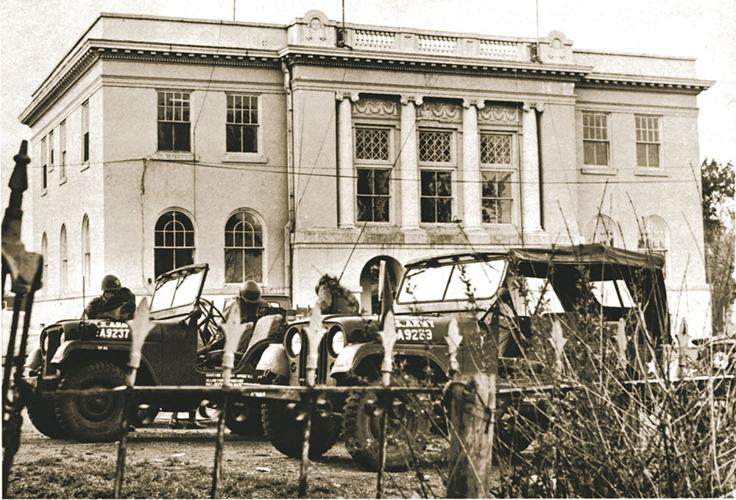
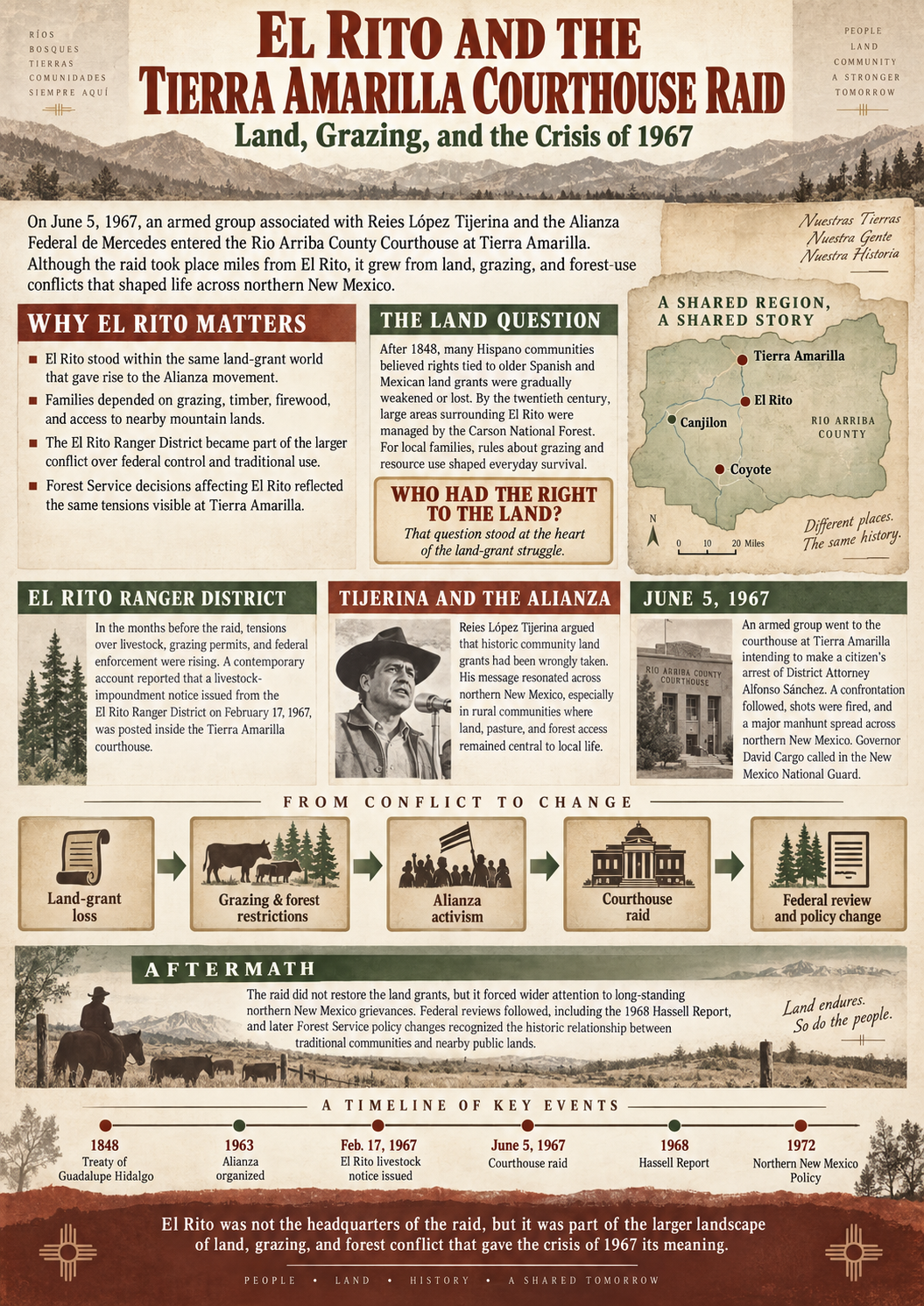
There are significant, documented connections between El Rito and the June 5, 1967 Tierra Amarilla courthouse raid, and some are much stronger than simple geographic proximity. The most important discovery is that one of the principal armed raiders, Baltasar “Baltazar” Martinez, used the vicinity of his mother's home in El Rito as a refuge during the massive post-raid manhunt. Equally important, the El Rito Ranger District of the Carson National Forest was itself involved in grazing, timber, and land-use disputes that were closely intertwined with the grievances being advanced by Reies López Tijerina and the Alianza Federal de Mercedes immediately before the raid.
My research suggests that El Rito belongs in the story of Tierra Amarilla in at least seven distinct ways.
| El Rito connection | What the evidence shows | Strength |
|---|---|---|
| Baltasar Martinez | Courthouse raider hid near his mother's El Rito home following the raid | Very strong/direct |
| El Rito Ranger District | Grazing restrictions and loss of permits were among the grievances affecting northern Hispano communities | Strong |
| Forest Service notice inside the courthouse | An El Rito Ranger District livestock-impoundment notice reportedly hung in the Tierra Amarilla courthouse itself in early 1967 | Very strong/symbolic |
| Vallecitos Sustained Yield Unit | El Rito-administered forestry program was already under pressure from Tijerina/Alianza before June 1967 | Strong |
| Alianza geographic network | El Rito appears on a September 1967 activist map of the land-grant movement's northern New Mexico territory | Moderate |
| Raid's policy aftermath | The raid helped trigger Forest Service reforms that subsequently governed El Rito District decisions | Strong |
| Later participants and El Rito disputes | Courthouse raider Moises Morales later became involved in litigation over grazing in the El Rito District | Strong legacy connection |
1. Baltasar Martinez: the clearest personal connection to El Rito
Baltasar Martinez was only about 22 years old when he participated in the June 5 raid. Contemporary and retrospective accounts describe him as one of the principal participants and sometimes as one of Tijerina's bodyguards. He was among the men who entered the courthouse, and after the shooting and confusion, Martinez became part of the group fleeing into the mountains. A New Mexico Film Office account of the later documentary The Dynamite Kid identifies him as "one of the principal raiders" and notes the extraordinary manhunt mounted for him.
The crucial El Rito connection comes from journalist Peter Nabokov's account, subsequently reported by the Associated Press. Martinez remained hidden for more than a week near his mother's home in El Rito. He occasionally approached the house for food while National Guard troops and police searched the region.
Eventually, Martinez's mother provided authorities with the information that led to his capture. According to the account, she collected the $500 reward offered by Governor David Cargo, but said she turned in her son because she feared authorities would otherwise kill him.
That is a major discovery for an El Rito history exhibit because it means that the aftermath of the Tierra Amarilla raid physically reached El Rito. The village was not merely somewhere down the road from the action. One of the most intensely sought participants was sheltering immediately around an El Rito family home while one of the largest law-enforcement mobilizations in New Mexico history was underway.
There is a little geographic complexity worth preserving. Martinez also had strong connections with Canjilon, and some accounts call that his hometown. He was ultimately buried there. Therefore I would not describe him without qualification as "an El Rito native." The more defensible wording is:
Courthouse raider Baltasar Martinez had close family and later residential ties to El Rito and hid near his mother's El Rito home during the post-raid manhunt.
Martinez eventually returned to the El Rito area. In 2007 he was living at a small home in El Rito when he was shot and killed during a local property dispute. Contemporary coverage specifically described him as a former Tierra Amarilla courthouse raider.
That gives El Rito a remarkable 40-year connection with one of the raid's participants—from his flight from authorities in 1967 to his death in El Rito in 2007.
2. An El Rito Ranger District enforcement notice was reportedly posted inside the courthouse
This may be the most striking institutional connection I found.
Writer Stan Steiner, in his account of the land-grant struggle, described the bulletin board at the Rio Arriba County Courthouse in Tierra Amarilla shortly before the June raid. Among the government notices was a Forest Service warning concerning livestock within an allotment of the El Rito Ranger District, Carson National Forest.
The document was an official notice of intended impoundment of trespassing livestock and had been signed at El Rito on February 17, 1967—less than four months before the courthouse raid.
Consider the symbolism: people entering the courthouse during this highly charged land-grant struggle could encounter a federal notice originating from El Rito warning livestock owners that animals considered unlawfully grazed on federal land could be impounded.
The courthouse raid was fundamentally about land, authority, and the legitimacy of governmental control over property that many Hispano families believed had historically belonged to their communities. The presence of an El Rito Ranger District enforcement notice in that very building provides a tangible connection between those abstract grievances and everyday life.
I would consider this potentially important enough for an El Rito Library exhibit panel: a reproduction of the actual 1967 Forest Service notice, if the original can be located.
3. Grazing restrictions in the El Rito Ranger District were part of the larger grievance
This connection goes deeper.
The Alianza struggle is sometimes reduced to the question of ownership of old Spanish and Mexican land grants. In rural northern New Mexico, however, the controversy also involved something much more immediate:
Could local Hispano families continue using mountains and forests for sheep, cattle, timber, firewood and other resources as their families had for generations?
Research on Forest Service policy in northern New Mexico documents increasing restrictions upon traditional grazing. Historian/geographer David Correia has documented conflicts between Hispano permittees and the Forest Service's El Rito Ranger District, including local perceptions that ostensibly scientific "range improvements" were being used to restrict traditional access.
Steiner's contemporary account went even further, reporting that by 1967 thousands of lambing permits associated with El Rito had been withdrawn and that livestock permits throughout Rio Arriba County had been sharply reduced.
The precise numerical estimates in contemporary activist-oriented accounts should be treated cautiously until checked against Forest Service permit ledgers. But the underlying conflict is well documented independently.
The National Park Service's Latino history study notes that much of what became the El Rito Ranger District had previously been community land-grant territory on which surrounding Hispano communities historically depended.
That is important because it explains why a seemingly technical dispute over sheep or cattle permits could become part of a much larger argument about conquest, the Treaty of Guadalupe Hidalgo, and land-grant dispossession.
4. The Vallecitos Federal Sustained Yield Unit creates another direct El Rito–Alianza connection
Another particularly interesting discovery involves the Vallecitos Federal Sustained Yield Unit (VFSYU).
The unit was established to provide local communities with access to timber and employment from national forest lands. But by the 1960s its management had become controversial, and records examined by historian David Correia show that Forest Service officials in the El Rito District were acutely aware of Tijerina and the Alianza.
This becomes especially important in early 1967.
Forest Service officials were considering abandoning or restructuring the Vallecitos program. Internal discussions recognized that the Alianza could exploit the controversy politically and connect forestry complaints with grazing and land-grant grievances.
Then came June 5, 1967.
Correia specifically places the Tierra Amarilla courthouse raid in the sequence of events surrounding Forest Service deliberations over the Vallecitos program. The raid suddenly brought national attention to exactly the social and land-management problems Forest Service officials in northern New Mexico—including the El Rito District—had been confronting.
So there was an institutional connection running in both directions:
El Rito-area Forest Service policies → growing local grievances → Alianza agitation → Tierra Amarilla raid → federal reconsideration of northern New Mexico Forest Service policies.
That is much more substantial than saying El Rito happened to be nearby.
5. El Rito appears on a 1967 map of the Alianza movement's northern New Mexico world
I also found a fascinating contemporary document dated September 16, 1967, only three months after the raid.
A Spanish-language movement publication carried a hand-drawn map associated with the "Pueblos Libres" campaign. On it appear Tierra Amarilla, Chama, Cebolla, Canjilon, Coyote, Vallecitos, Abiquiú—and El Rito.
This provides evidence that El Rito was regarded as part of the geographic and cultural landscape in which the land-grant movement was operating.
But there is an important distinction: I have not yet found sufficient evidence to state that the village of El Rito formally declared itself a "Pueblo Libre." The map demonstrates inclusion in the movement's regional geography, not necessarily formal political participation.
That distinction should be maintained in anything prepared for a historical exhibit.
6. El Rito had its own land-grant history
The federal government's later investigation of New Mexico land grants also catalogued "El Rito (Town of)" among historical New Mexico land-grant claims.
This matters because residents of El Rito were not simply observers of a Tierra Amarilla dispute. El Rito existed within precisely the same complicated historical world of Spanish/Mexican grants, communal use, federal ownership and contested access that gave the Alianza its appeal.
It does not, by itself, prove that the El Rito land grant formally supported Tijerina or the courthouse raid. But it helps explain why Tijerina's arguments would have resonated in the community.
7. The courthouse raid ultimately changed Forest Service policy affecting El Rito
One of the most important El Rito connections occurred after June 1967.
The violence and national publicity surrounding Tierra Amarilla caused senior federal officials to examine the Forest Service's treatment of traditional Hispano communities in northern New Mexico. That review resulted in the 1968 Hassell Report, containing numerous recommendations concerning Forest Service policy, including grazing.
This process eventually contributed to the Forest Service's Northern New Mexico Policy, adopted by Region 3 in 1972. The policy explicitly acknowledged the distinctive cultural relationships of traditional Hispano and Indigenous communities to national forest lands.
Because the El Rito Ranger District administered large areas used by traditional Hispano communities, El Rito became one of the places where the policy created in the aftermath of Tierra Amarilla actually mattered on the ground.
This connection remained alive decades later.
In 2012, rancher Moises Morales—who had participated in the 1967 courthouse raid as a teenager—joined other northern New Mexico ranchers in litigation challenging grazing reductions imposed by the El Rito District Ranger on the Jarita Mesa and Alamosa allotments. The ranchers specifically invoked the 1972 policy that had emerged from the federal response to the unrest of the 1960s and the Tierra Amarilla episode.
That creates an extraordinary historical circle:
1967: Morales participates in the Tierra Amarilla raid over land-related grievances.
1972: the Forest Service adopts a special Northern New Mexico policy partly because of the political crisis exposed by Tierra Amarilla.
2012: Morales and other traditional ranchers invoke that policy in a lawsuit concerning decisions made by the El Rito Ranger District.
Few connections could demonstrate more clearly that the Tierra Amarilla controversy and El Rito's land-use history belong in the same narrative.
DEATH OF BALAZAR MARTINEZ
EL RITO —One of the land grant activists who staged an armed raid on the Rio Arriba County courthouse four decades ago has been shot dead in front of an El Rito home in what deputies described as an ongoing dispute with another man. Baltazar Martinez, 62, of El Rito, was killed Thursday and Tony Herrera, also of El Rito, was arrested on an open count of murder. According to a report by a Rio Arriba County sheriff’s deputy, Herrera shot Martinez in the arm and back about 7 p.m. Thursday in front of the El Rito home of Herrera’s former wife, Corrine Herrera, on N.M. 215. Martinez had been living with Corrine Herrera, and the parties were involved in an “ongoing feud,” Deputy James Lujan said Friday. Corrine Herrera was inside the house and did not see the shooting, Lujan said. Officers arrested Tony Herrera at his home a few minutes after the shooting, authorities said. Tony Herrera, age unknown, was being held in the Rio Arriba County jail. Martinez was 22 when he took part in the June 5, 1967, raid on the courthouse in Tierra Amarilla. He was charged with kidnapping, assault and other crimes, and jailed with the raid’s leader, Reies Lopez Tijerina, and other members of the raid. A jury acquitted Martinez, finding that he was temporarily insane.
According to “Tijerina and the Courthouse Raid,” a book by former New Mexican reporter Peter Nabokov, prosecutors initially considered Martinez more dangerous than Tijerina. Martinez had hid out for over a week after the raid near his mother’s El Rito home, showing up there occasionally for food while eluding National Guard troops and police. Martinez’s mother eventually collected the $500 reward offered by then-Gov. David Cargo for information leading to his capture. She said turned him in because she feared police would otherwise kill him. The group of raiders, called the Alianza, was trying to make a citizen’s arrest of the district attorney who was cracking down on the organization. During the raid, members of the group shot and wounded a jailer and a state police officer and took a reporter and the then-sheriff hostage. Both later escaped.