
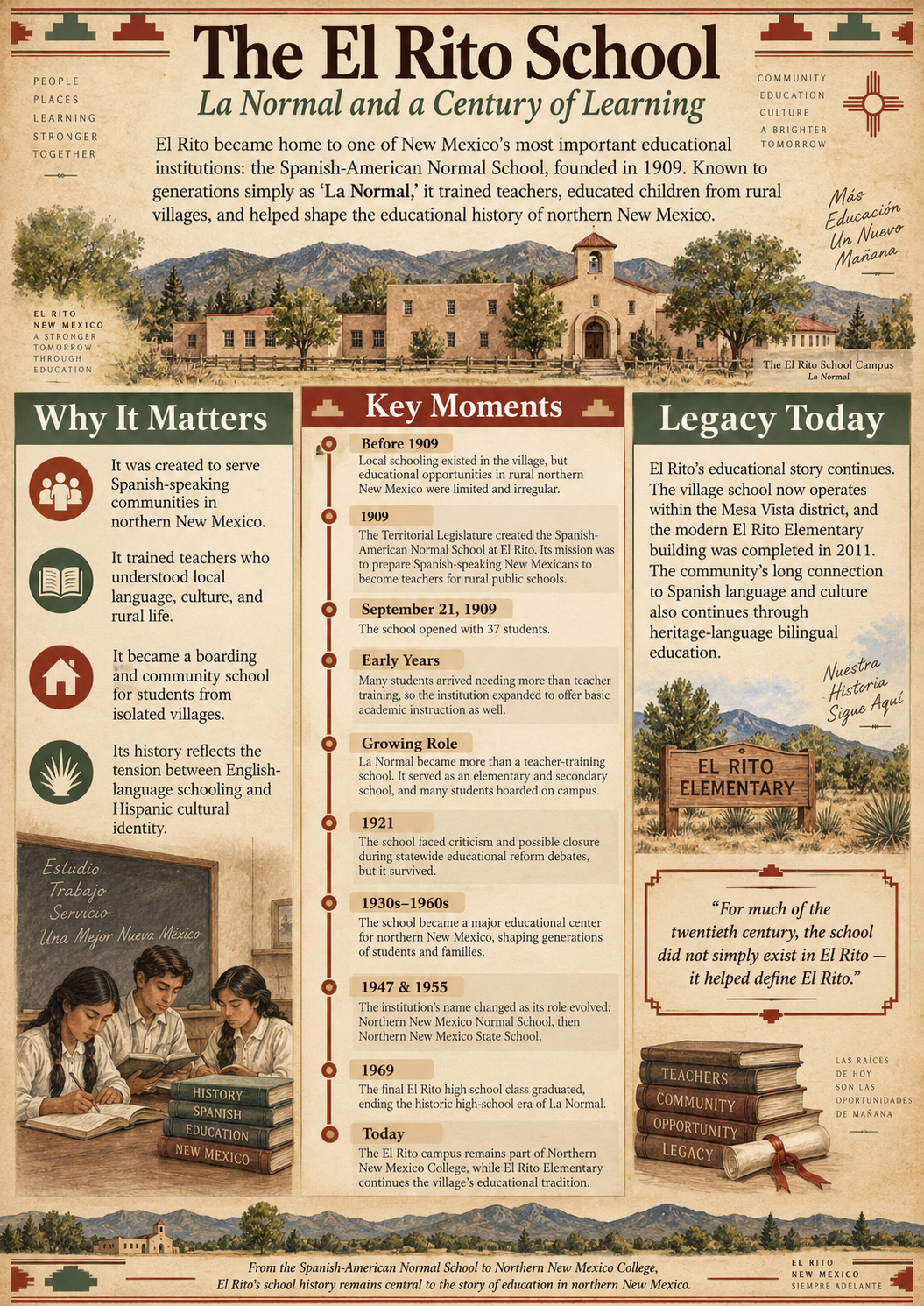
The Normal School at El Rito began with a clear purpose: to prepare teachers for the scattered communities of the Río Arriba, where schools were few and Spanish remained the language of daily life. Sixty years after New Mexico became a United States territory, territorial leaders believed that expanding English-language education would strengthen their case for statehood. Three years later, New Mexico joined the Union.
Once students arrived, school officials discovered how much work lay ahead. Many young people had received too little schooling to begin training as teachers. They first needed instruction in reading, writing, and arithmetic. Across northern New Mexico, isolated villages, limited communication, and poor roads had made it difficult for officials to understand the extent of the need. The school adapted, and students soon found a place willing to begin where they were and help them move forward.
During its early decades, the Normal School trained as many as one hundred teachers. Over time, however, its work increasingly centered on elementary and high school education. Its boarding campus welcomed students from across New Mexico, including children who left home at a very young age. For those students, the school became a community of its own, with familiar routines, lasting friendships, and traditions they carried into adulthood.
Former students remembered more than their lessons. They remembered the feeling of belonging, the respect they developed for one another, and the shared belief that education could open doors. Their accounts reveal a part of New Mexico’s history that deserves to be better known: how children from distant communities came together in El Rito and built bonds that lasted long after their school years ended.
The El Rito School: From the Spanish-American Normal School to the Present
by Dave Warren
The history of education in El Rito is much larger than the history of a single school building. El Rito became the home of one of New Mexico's most unusual and culturally significant educational institutions—the Spanish-American Normal School, commonly remembered simply as “La Normal.” Established in 1909 specifically to address the educational needs of Spanish-speaking northern New Mexicans, the school eventually operated at various times as a teacher-training institution, elementary and secondary school, boarding school, vocational school, and college. Its institutional descendant is today's Northern New Mexico College.
Before the Normal School
Formal public education in rural northern New Mexico was limited during much of the nineteenth century. Schools were often small, irregularly funded, and dependent upon local teachers who themselves had relatively little formal training. Spanish remained the everyday language of most villages in Rio Arriba County, while the territorial government increasingly expected public education to be conducted in English.
By the beginning of the twentieth century, New Mexico faced a serious problem: many rural communities needed teachers who could communicate with children whose first language was Spanish. The National Park Service identifies El Rito's Normal School as an important example of the political influence exercised by New Mexico Hispanos, who sought teachers and educational institutions responsive to their communities rather than simply importing English-speaking teachers from elsewhere.
I have not yet found documentary evidence establishing the precise date of El Rito's first village school before 1909. There almost certainly was local schooling before La Normal, but distinguishing a permanent public school from temporary or privately conducted village classes will require examination of Rio Arriba County school-superintendent records, territorial education reports, census schedules and local family papers. That is one area worth pursuing much more deeply.
1909: The Spanish-American Normal School Is Created
The decisive moment came during the 1909 session of the New Mexico Territorial Legislature.
The legislature passed Chapter 97 of the Laws of 1909, establishing the Spanish-American Normal School at El Rito. The original statute is unusually revealing about what legislators intended the institution to accomplish.
Its stated purpose was to educate Spanish-speaking New Mexicans to become teachers in public schools in areas where Spanish predominated. The curriculum was specifically to prepare those teachers to provide instruction in English, particularly in rural schools serving children from Spanish-speaking families.
The founding legislation also required:
- students to have completed at least the fourth grade, or pass an examination qualifying them for fifth grade;
- graduates to agree to teach for at least two years in New Mexico public schools, unless excused by the State Board of Education;
- the institution to concentrate upon preparing teachers for ordinary rural schools.
This makes the school's original mission more complicated than simply calling it either a Spanish-language school or an Americanization school. It was both a response to the educational needs of Hispanic New Mexico and part of the territory's effort to expand English-language public education.
The National Park Service nevertheless notes an important distinction between New Mexico and states such as Texas and California: Hispano political leaders in New Mexico had enough influence to shape teacher training themselves and to insist that Hispanic heritage have a place within public education.
Why El Rito?
Northern New Mexico College credits three political figures in particular with securing the institution:
Venceslao Jaramillo, an influential El Rito businessman, landowner and territorial legislator;
Salomon Luna, an important New Mexico political leader associated with Tierra Amarilla and northern New Mexico;
and L. Bradford Prince, former territorial governor and later a territorial senator representing Rio Arriba County.
Their political efforts helped overcome opposition to establishing another state-supported educational institution in a relatively remote Hispanic village.
That El Rito was selected rather than a larger community is significant. The school was deliberately placed among the rural population it was intended to serve.
September 21, 1909: The Doors Open
The Spanish-American Normal School formally opened in El Rito on September 21, 1909. Northern New Mexico College and its alumni association report an initial enrollment of only 37 students.
But those first students immediately exposed a problem.
Theoretically, a normal school was supposed to take students who had already completed substantial elementary or secondary education and prepare them professionally to become teachers. Many young people arriving from isolated northern New Mexico villages had not had that opportunity.
Former Northern New Mexico College president Sigfredo Maestas describes how the institution discovered that many prospective students first needed instruction in basic reading, writing and arithmetic before they could begin professional teacher preparation. Consequently, the school adapted to its students rather than simply rejecting them.
That decision ultimately transformed La Normal.
Instead of remaining exclusively a teacher-training college, it gradually became an institution where children and young adults could obtain much of the education that their home communities could not yet provide.
A School Becomes a Community
The El Rito Normal School eventually operated as far more than a college.
It developed elementary and secondary education, and because many students came from distant villages, it became a boarding school. Young people from across northern New Mexico could live on the El Rito campus while attending classes.
This helps explain the unusually strong attachment former students developed toward “The Normal.”
The campus became a self-contained educational community—classrooms, dormitories, meals, athletics, dances, school organizations, friendships and, for many students, their first sustained experience away from their home village.
It also meant that El Rito itself became an educational center serving an area vastly larger than the village.
A 1912–13 directory identifies Francisco Delgado as president of the Spanish-American Normal School. Delgado would become sufficiently associated with the institution that Delgado Hall, one of the historic campus buildings, bears his name.
The School's Difficult Early Years
La Normal was never guaranteed survival.
Its enrollment was small, El Rito was geographically isolated, transportation was difficult, and state officials periodically questioned whether such a small institution justified its expense.
One of the starkest examples occurred in 1921.
Educational reformer William C. Bagley conducted a study of New Mexico's state educational institutions for the Special Revenue Commission. Bagley did not personally visit El Rito, an important qualification when evaluating his conclusions. Nevertheless, his report questioned the effectiveness of maintaining a separate institution for training teachers of Spanish-speaking children.
Other educators commenting upon Bagley's recommendations went considerably further. They advocated closing the El Rito institution and argued that Spanish-speaking teachers should instead be educated alongside Anglo teachers, explicitly tying education to the “Americanization” of New Mexico's Hispanic population.
The recommendation was not carried out.
La Normal survived.
That survival is historically important because it preserved a state educational institution in rural northern New Mexico at a time when influential education reformers were recommending centralization elsewhere.
The Normal School in the 1920s and 1930s
Evidence shows the institution continuing its teacher-training mission into the 1920s while simultaneously providing broader education.
It even operated summer sessions for teachers. Federal education directories list the Spanish-American Normal School conducting summer programs during the decade, allowing working teachers to continue their education and improve their credentials.
By the 1930s the institution had become important enough to attract academic study. In 1939, Carl Robert Jensen completed a University of New Mexico master's thesis entitled A Study of the Spanish-American Normal School at El Rito.
Jensen noted how surprisingly little published information existed about the school despite its status as a state institution. His study attempted to examine El Rito's social environment, the school's internal organization and ways the institution could better accomplish its mission.
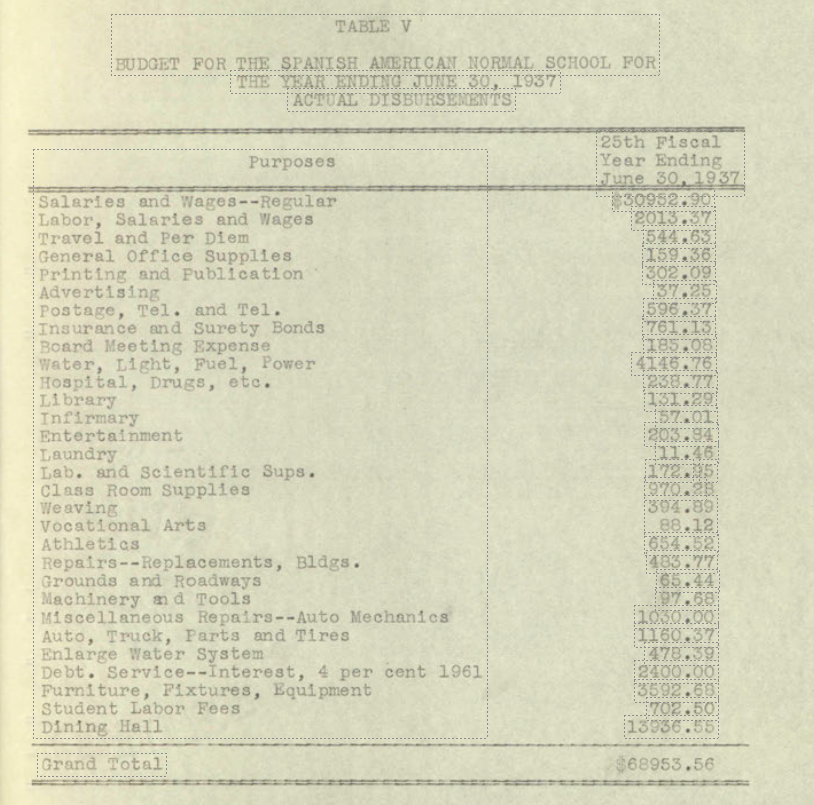
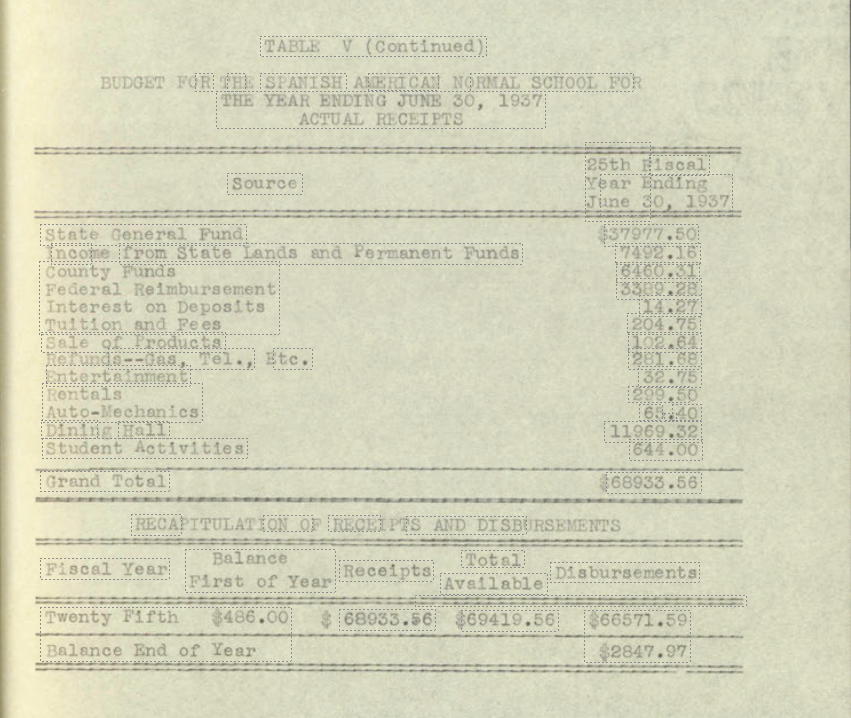
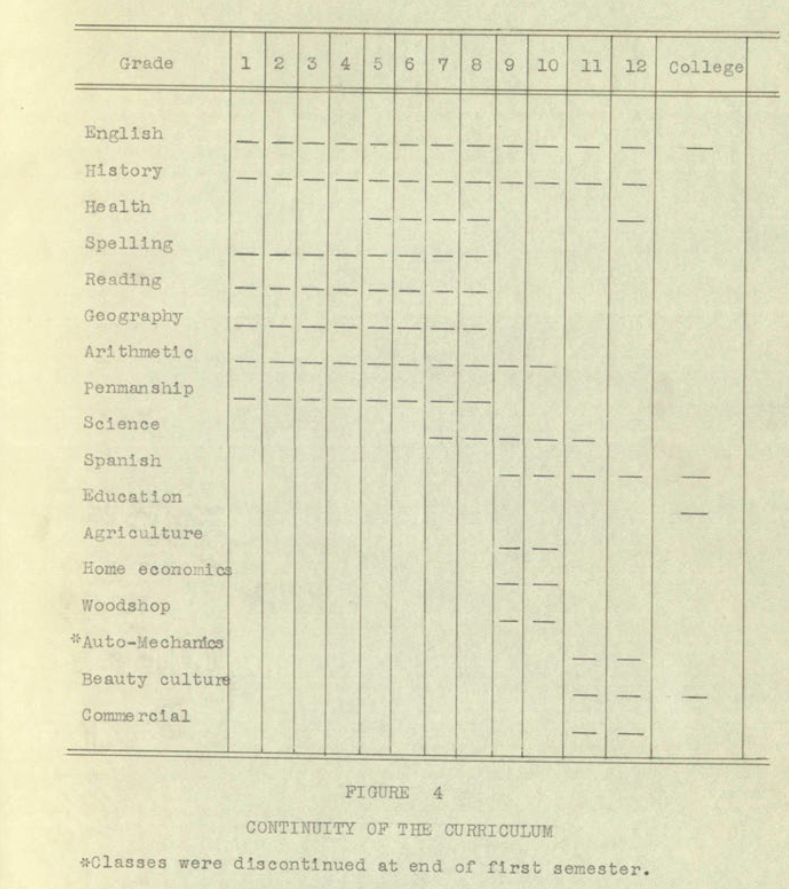
ABOVE: CLASSES OFFERED IN 1937 (his thesis was published in 1939)
BELOW: THE SEX AND ANCESTORY OF THE STUDENT BODY FOLLOWED BY WHERE THEY CAME FROM
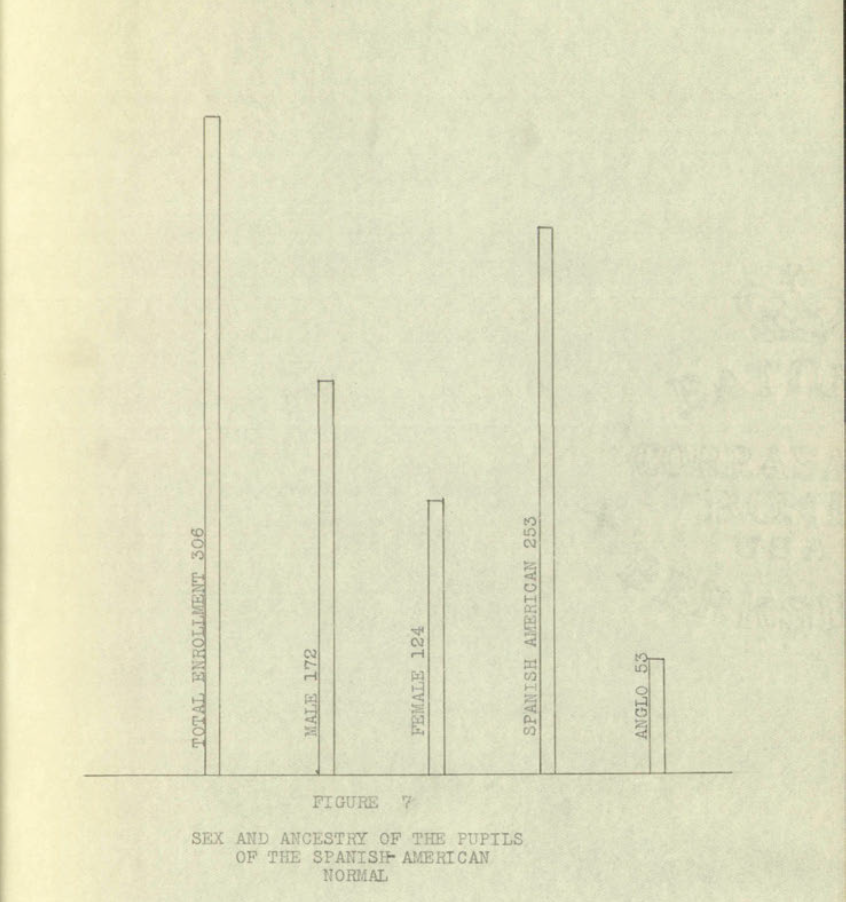
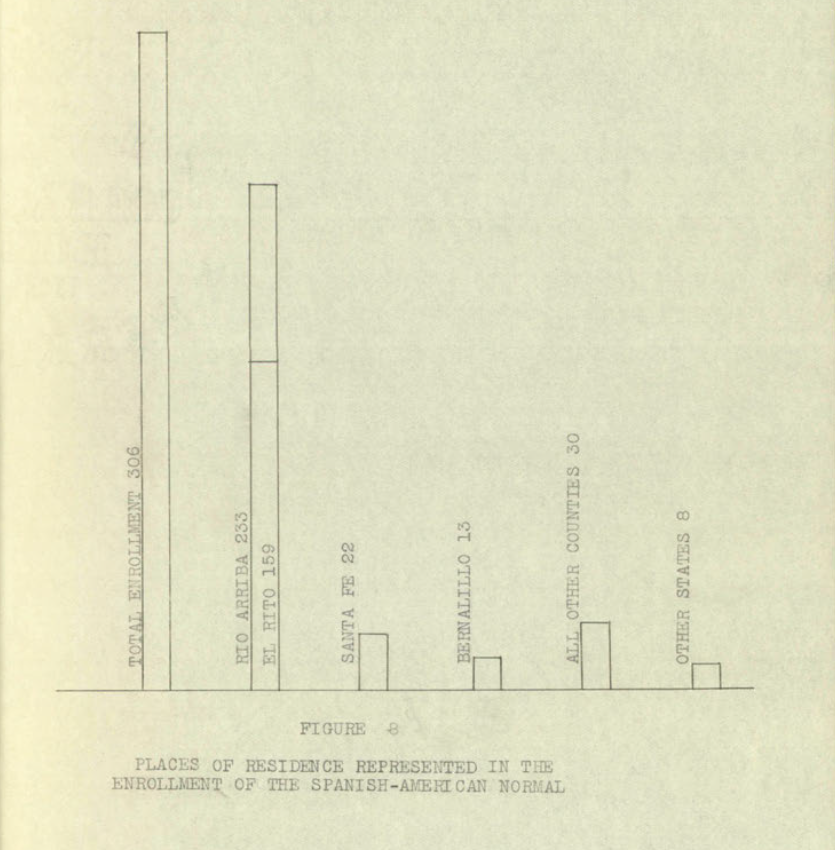
Spanish, English and Identity
One of the most interesting themes running through the school's history is language.
The 1909 law was clear: teachers were being trained to teach English to children from Spanish-speaking families.
Yet the very existence of the school also represented recognition that northern New Mexico's Spanish-speaking population could not effectively be educated by pretending Spanish did not exist.
Teachers who understood children's language, families and culture were needed.
Thus La Normal existed in the middle of one of twentieth-century New Mexico's defining tensions:
How could Hispanic children become fully literate in English without education requiring them to abandon Spanish and their cultural identity?
That question makes the El Rito school important well beyond Rio Arriba County. The National Park Service treats the institution as part of the broader history of Latino education in the United States.
Northern New Mexico College today describes the 1909 institution as the nation's first Hispanic-serving institution, although the modern federal designation “Hispanic-Serving Institution” did not yet exist.
From Normal School to High School
As public education improved throughout northern New Mexico, the institution's purpose continued changing.
La Normal increasingly became known not simply as a place where teachers were trained but as the school where generations of northern New Mexico students received their elementary and high-school educations.
Sigfredo Maestas's history describes the boarding campus as attracting students from across New Mexico, sometimes at quite young ages. Over time, the institution developed strong school traditions and a powerful alumni identity.
The Northern New Mexico Normal School Alumni Association has preserved class photographs, oral histories, memorials and other records documenting these students.
The Changing Names of the School
The naming history is confusing because institutional histories sometimes simplify it.
The legal record gives this progression:
| Year | Development |
|---|---|
| 1909 | Spanish-American Normal School established |
| 1947 | Legislature authorized use of Northern New Mexico Normal School |
| 1955 | Legislature authorized use of Northern New Mexico State School |
| 1959–1960 | Constitutional amendment reaffirmed Northern New Mexico State School as a state educational institution |
| 1969 | Final El Rito high-school graduating class |
| 1970 | Institution began using New Mexico Technical-Vocational School |
| 1977 | Became Northern New Mexico Community College |
| 2005 | Northern New Mexico College name formally adopted in statute |
The 2009 New Mexico Legislature's centennial memorial specifically documents the 1947 and 1955 changes.
Northern's own institutional timeline uses a somewhat simplified chronology, including a 1953 name-change date. For a museum exhibit, I would use the legislative chronology where the two conflict.
1969: The End of the El Rito High School Era
The greatest change came in 1969.
Northern's high-school curriculum was transferred to the newly organized public-school system. The Class of 1969 became the last senior class to graduate from the historic El Rito institution.
That date marks the end of an extraordinary 60-year period, 1909–1969, during which La Normal had served successive generations of northern New Mexicans.
Afterward, the El Rito institution concentrated increasingly upon technical and vocational education, while public elementary and secondary education became the responsibility of the school district.
The institution expanded into Española in the early 1970s, and over time the Española campus became the primary center of what is now Northern New Mexico College.
El Rito Elementary School
The village did not cease having a public school when the Normal School's secondary program ended.
Today El Rito Elementary School belongs to Mesa Vista Consolidated Schools, along with Ojo Caliente Elementary and Mesa Vista Middle/High School.
The existing El Rito Elementary building is relatively new. New Mexico Public School Capital Outlay records state that it was completed in 2011, describing it in 2014 as the newest addition to the Mesa Vista district.
Importantly, the linguistic issue that helped create La Normal in 1909 has not entirely disappeared from El Rito education. New Mexico Public Education Department records for 2023–24 identify El Rito Elementary, grades K–3, as operating a Spanish heritage-language bilingual/multicultural education program.
There is something remarkable in that continuity:
In 1909 El Rito became an educational center because northern New Mexico children spoke Spanish. More than a century later, Spanish language and cultural heritage remain formally represented in the village school.
Delgado Hall and the Surviving Campus
The historic Normal School campus still exists.
Delgado Hall was entered on the New Mexico Register of Cultural Properties on May 9, 1986, recognizing the campus's historical significance.
Northern New Mexico College retains its El Rito campus, and the site continues to be used for educational and community purposes. The grounds are also open to the public.
The Northern New Mexico Normal School Alumni Association remains closely connected with the campus. It maintains the El Portal del Águila memorial wall and orchard, preserves historic class photographs and oral histories, and continues reunions and heritage activities. In 2023 the association received $150,000 in federal funding to establish a Legacy Archive Center devoted to preserving the Normal School's history.
Why the El Rito School Matters
The research suggests that the most powerful way to interpret the school is not simply:
“El Rito once had a Normal School.”
Its larger historical importance is this:
A tiny rural Hispanic village became the location of a state institution created to solve one of New Mexico's most difficult educational problems.
For sixty years, children came down mountain roads and out of isolated villages to El Rito. Some arrived expecting to become teachers but first needed elementary instruction themselves. Some boarded there as children. Some learned English there. Others became teachers and returned to communities much like the ones they had left.
Generations attended its elementary and high-school classes, played sports, lived in dormitories, formed friendships, married fellow students, and carried the identity of “The Normal” with them for the rest of their lives.
In that sense, the El Rito school was not simply located in the village. For much of the twentieth century, it was one of the institutions that defined El Rito.
The folks interviewed in this video were students at the El Rito, New Mexico Boarding School, also known as the Spanish American Normal School. Individuals who narrated parts of this video or who were interviewed include, but are not limited to: Tilly S. Kitchens, Eloisa Gallegos Rodriguez, Ralph Martinez, Ernest Santistevan, Cecilia Gonzales de Tucker, Ted Martinez, and some family footage was provided by Joseph B. Grant and Jim Grant.There are no copyrights associated with this film, and original filming credits go to Northern Rio Grande National Heritage Area to the Northern New Mexico Normal School Alumni Association.