
Eating in El Rito: A History of Cafés, Stores, Dining Halls and Family Restaurants
The history of eating in El Rito is more interesting than a simple list of restaurants suggests. El Rito was never large enough to support a long row of cafés and diners. Instead, food was woven into the village’s institutions and family businesses. Students ate at the Normal School dining hall; families bought groceries and later hot food at Martin’s; the Garcia family operated El Llano Mercantile; Peter and Florence van Dresser experimented with a remarkably early local-food restaurant; and the Trujillo family eventually made El Farolito one of northern New Mexico’s best-known small restaurants.
The emerging chronology
| Period | Place | What we can document |
|---|---|---|
| 1909 onward | Spanish American Normal School | Boarding students created the first large-scale institutional dining operation in El Rito. |
| 1925/1930–2009 | Martin’s General Store | Groceries, meat, candy, produce and other foods; later coffee and hot prepared chicken. |
| By at least the 1940s | El Llano Mercantile / Garcia’s Store | A Garcia-family mercantile, later also associated with a bar, gas and eventually prepared meals. |
| c. 1949–1970 or later | Peter & Florence van Dresser’s restaurant / “Coffee House” | One of the most fascinating discoveries: an early restaurant emphasizing locally produced food. |
| 1983–present era | El Farolito | Carmen and Dennis Trujillo’s tiny family restaurant, later operated by their children. |
| 21st century | El Llano Bar and Mercantile | The old mercantile tradition has evolved to include made-from-scratch Northern New Mexican meals. |
Before restaurants: the Normal School dining hall
One of the earliest places in twentieth-century El Rito where substantial numbers of people regularly ate outside their own homes was almost certainly the Spanish American Normal School. It opened on September 21, 1909 and eventually became a boarding institution, drawing students from isolated communities throughout northern New Mexico. The school consequently had to provide not only classrooms and dormitories but meals for resident students.
This is important to the food history of El Rito. For decades, the dining hall would have been one of the largest kitchens in the village. Former students remembered the Normal as a self-contained community in which sleeping, studying, recreation and eating all occurred on campus. Although it was not a public restaurant, it was a major place of communal eating and probably employed local residents in food preparation and service.
That tradition survived long after the Normal School period. As recently as 2014, conference organizers warned visitors that the El Rito Campus Dining Hall would be their principal source of meals because other food choices were miles away. In 2025, Northern New Mexico College reopened historic dormitory and dining facilities to resident students after more than a decade.
This gives the dining hall a remarkable span in El Rito's story: from the boarding-school culture of the early twentieth century to the restored campus of the twenty-first.
Martin's General Store: where groceries, conversation and eventually hot food came together
The history becomes more personal with Martin's General Store.
Michael Martin, grandson of George Martin Sr., recalled that his grandfather returned to El Rito in 1925 and entered a partnership with John Sargent. That partnership eventually ended, and around 1930 George Martin was operating on his own at the location remembered by generations simply as Martin's Store.
Martin's was much more than a grocery store. It sold groceries, dry goods, candy, livestock feed, hardware, horseshoes, plumbing supplies and gasoline. In its early years customers did not walk around filling shopping carts. They brought their lists to the counter and the proprietor assembled their orders. That naturally turned waiting for groceries into visiting time. Michael Martin specifically remembered the store as an important social center, helped by the fact that the old post office stood across the road.
A wonderful local recollection adds another dimension. Raymond Ortega remembered his father having coffee in the back of Martin's and visiting with George Lucero, who worked as the butcher and also tended the pumps and garage. This is oral history rather than a business record, but it suggests that Martin's functioned informally as a gathering and refreshment place as well as a store.
By the early 2000s, Martin's had become even more clearly part of El Rito's ready-to-eat food landscape. A 2003 food story described WondeRoast chickens turning on rotisseries inside Martin's General Store, while El Farolito operated just across the road. Thus a visitor could obtain hot chicken at the general store even though Martin's was never formally a restaurant.
Martin's finally closed on August 29, 2009, after roughly eight decades of service at that location. Greg Martin had operated it since approximately 1974. Its disappearance meant that residents lost not simply a shop, but groceries, prepared food, gasoline and one of the village's traditional meeting places.
El Llano Mercantile: “Garcia's Store”
At the other end of town stood another important piece of this history: El Llano Mercantile, remembered simply by some residents as Garcia's Store.
The business is older than I initially expected. A particularly useful piece of evidence appears in a 1970 memoir by David Robertson. Describing his arrival in El Rito that summer, Robertson remembered the village as having Martin's store at one end and Garcia's store at the other.
There is firmer documentary evidence that the Garcia business existed even earlier. A 1966 Congressional Record entry gives an address for Dennis Garcia “% El Llano Mercantile, El Rito,” establishing both the Garcia association and the mercantile name by the mid-1960s. Earlier biographical evidence I located during the search also places employees at El Llano Mercantile in the 1940s, meaning the store's roots deserve additional investigation.
It appears to have combined several functions over time: mercantile, groceries, drinks, gasoline and a bar. That makes it similar to Martin's in one respect—these rural businesses survived by being many things at once.
The forgotten restaurant: Peter and Florence van Dresser's Coffee House
This may be the most important discovery in the research.
Peter van Dresser is remembered primarily as El Rito's pioneer of solar energy, ecological design and decentralized living. But Peter and Florence van Dresser also operated a restaurant in El Rito.
David Robertson, who came to El Rito in 1970 to work with van Dresser, gives direct eyewitness evidence. He wrote that:
“Peter and Florence owned a restaurant in El Rito.”
Robertson and other young people working for van Dresser occasionally ran it themselves. During the summer of 1970, Peter and Florence even left the restaurant in their hands while they were away.
Van Dresser saw the enterprise as much more than a way to sell meals. According to the surviving recollections, he regarded it as a low-impact local business that could serve villagers and visitors while demonstrating his philosophy of local economic self-sufficiency. The van Dressers tried to use locally produced food whenever practical.
That puts the restaurant squarely within Peter's broader experiments in El Rito: solar heat, wind power, local agriculture, appropriate technology and economic decentralization.
Even more intriguing is testimony from the van Dresser family. In response to a question from somebody who remembered eating there during the late 1960s, Peter's stepson Steve van Dresser identified the establishment as:
“The Coffee House in El Rito”
and stated that it had been founded, owned and operated by Peter and Florence. The questioner independently remembered its blue-corn tortillas.
Taken together, those accounts give us quite strong evidence for a real establishment known as The Coffee House operating by the late 1960s and continuing into 1970.
There is an intriguing possibility that it began much earlier. Peter and Florence came to El Rito in 1949, and accounts of Peter's early years indicate that they acquired a small local restaurant after arriving. If that chronology can be nailed down through deeds, business records or the Peter van Dresser papers, the Coffee House could turn out to be the earliest clearly identifiable commercial restaurant yet located in twentieth-century El Rito.
El Farolito: the restaurant that became famous
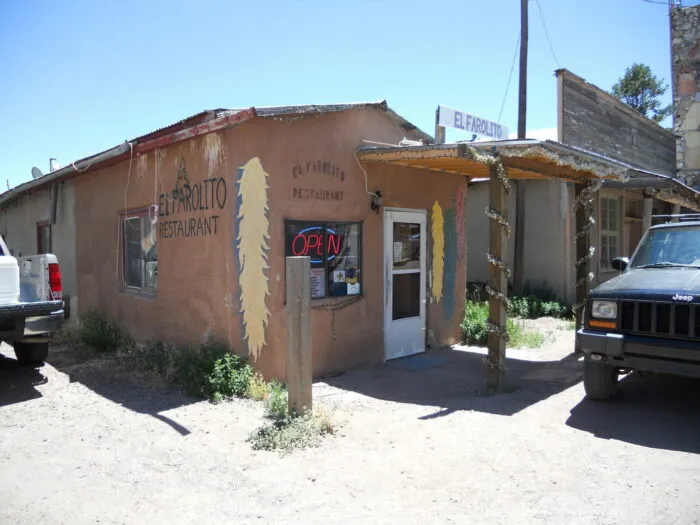
Then comes the establishment most people now associate with eating in El Rito: El Farolito.
There is an interesting conflict in the published history.
One local article states that a café at the site may have begun sometime around the 1960s, with Dennis and Carmen Trujillo becoming involved around 1975. The author explicitly admits that the early date is difficult to establish.
But several stronger pieces of evidence point to 1983 as the beginning of the Trujillo family's restaurant.
In a January 2025 interview, Dominic Trujillo stated that his parents opened the restaurant in 1983, when he was ten. An earlier food article published in 2003 likewise described Carmen and Dennis Trujillo as having opened El Farolito twenty years earlier—again producing a date of approximately 1983. A more recent Taos-area account similarly describes Carmen and Dennis as having started the business about forty years earlier.
El Farolito remained tiny. That's part of its identity. The dining room has only a handful of tables, and the kitchen and dining area blur together in the way many old rural New Mexico establishments do.
Its reputation, however, became much larger than its physical size. The family's red and green chile became especially celebrated. Carmen and Dennis's children eventually became deeply involved; Dominic Trujillo has spent decades cooking there, while his sister Christina Sanchez has helped operate the front of the restaurant.
For most of El Rito's history, the village did not divide life neatly into “grocery store,” “restaurant,” “coffee shop,” “bar” and “community center.” A single place might perform several of those functions.
Martin's sold groceries and meat, but people drank coffee and visited there. El Llano was a mercantile, gas stop and bar before becoming a place where substantial meals could be purchased. The Normal School's dining hall wasn't a restaurant at all, yet fed more people on a regular basis than most village restaurants ever could. Van Dresser's Coffee House was simultaneously a restaurant and an experiment in locally based economics. El Farolito became both a restaurant and a social gathering place where customers wandered into the kitchen to talk with the cooks.
That makes the history of eating in El Rito fundamentally a history of community.
And there is a striking continuity. In a 2021 archaeological-conference program, organizers warned visitors that there was essentiallyone restaurant in El Rito—El Farolito—and no grocery store. Conference participants were therefore encouraged to plan carefully. It was a modern reminder of something El Rito residents had always understood: in an isolated rural village, the places where food could be bought or shared mattered enormously.