How the Counterculture
Changed El Rito
Homes, work, and community in the 1960s and 1970s
On the Fourth of July in 1968, members and friends of the Hog Farm joined El Rito’s parade. Photographer Lisa Law recorded them and their bus, the Road Hog, in pictures now held by the Smithsonian. The national counterculture had arrived in a very local setting: a village celebrating Independence Day. Those photographs give the era a date, a place, and human faces. 1
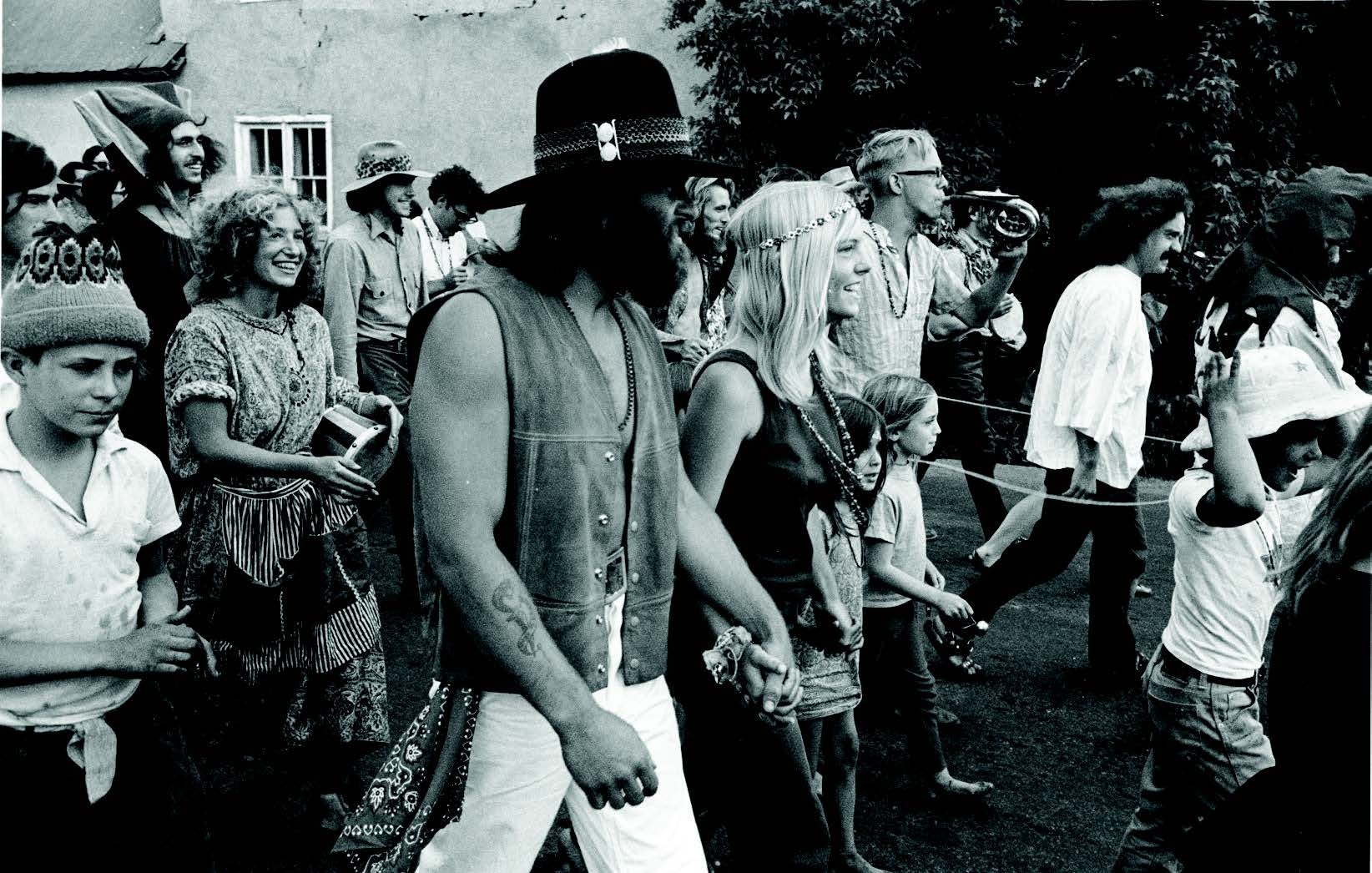
The deeper changes unfolded over years. People came through El Rito looking for freedom, artistic possibilities, or a life closer to the land. Some stayed, built homes, raised families, taught, and volunteered. Their accounts suggest that the movement’s lasting influence lay in these everyday commitments. New approaches to housing and livelihoods took shape through contact with a community that already possessed its own knowledge, institutions, and ambitions.
El Rito’s agricultural life rested on relationships between irrigated fields, upland grazing, and shared responsibility for water. Research by New Mexico State University, including work in El Rito, describes acequias as both irrigation systems and institutions of community government. Water users maintained ditches, shared obligations, and negotiated access to a scarce resource. Anyone seeking an independent rural life was entering a landscape already organized around interdependence. The newcomers’ enthusiasm for cooperation encountered practices that local families had sustained across generations. 2
Those same decades brought an urgent struggle over land and economic power. Historian and geographer David Correia documents how grazing restrictions and forest-management decisions affected communities served by the El Rito Ranger District. By 1967, district officials were explicitly worried about the influence of Reies López Tijerina’s land-grant organization, La Alianza. The June 5 courthouse raid in Tierra Amarilla brought national attention to the grievances of land-grant heirs; afterward, the Forest Service withdrew a proposal to dismantle the Vallecitos Federal Sustained Yield Unit. 3
This political setting matters to the story of the counterculture. For a newcomer, land could represent a chance to start over. For a family defending inherited rights and a rural livelihood, it carried obligations and claims rooted in a much longer history. These experiences occupied the same region during the same years. An account of El Rito’s transformation has to make room for both, without assuming that their interests or understanding of freedom were identical. 3
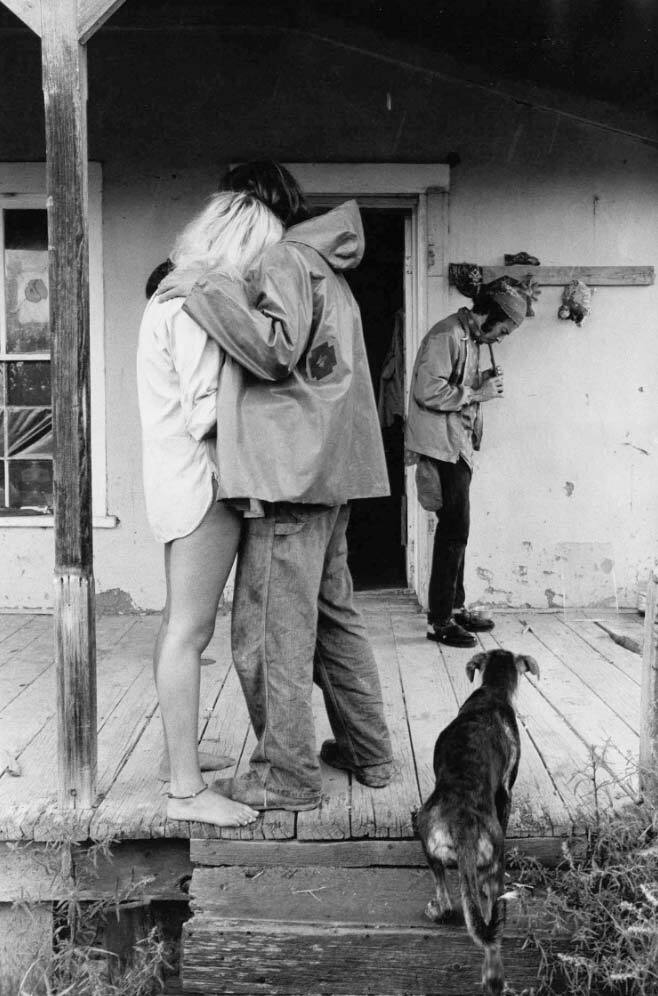
By 1966, El Rito was already connected to a growing network of people moving into northern New Mexico. Benjamin Klein writes that his uncle, photographer Irwin Klein, first came to the village that year. Irwin returned to the region repeatedly, documenting daily activities and celebrations. Some newcomers established households in villages such as El Rito and Vallecitos; others joined communes. His photographs preserve evidence of a migration whose participants made many different choices about how to live. 4
El Rito also served as a meeting place for people who went on to create communities elsewhere. In an oral history published by New Mexico Magazine, Robbie Gordon recalled that his brother Dave, Rick Klein, and poet Max Finstein were together in El Rito in 1966 before land was purchased for New Buffalo. That commune was established in Arroyo Hondo, north of Taos. The Hog Farm later settled at Llano, near Peñasco. El Rito’s importance becomes clearer when these places are kept distinct: the village was part of a regional network of friendships, visits, and experiments. 5
The photographs also complicate easy nostalgia. Writing about Irwin Klein’s work in El Palacio, museum photo curator Daniel Kosharek emphasized the difficulties confronting the region’s newcomers, including shortages of money, hunger, addiction, and disagreements about their shared ideals. A Klein photograph reproduced with the article identifies Hog Farm members, including Wavy Gravy, in El Rito. Taken together, the images and accounts suggest an unsettled process of learning how to live, with celebration and hardship often close together. 6
Some of the ideas attracting the younger generation already had a foothold in the area. Peter van Dresser moved to northern New Mexico in 1949 and pursued solar energy, wind power, and decentralized communities. A 1975 Mother Earth News interview, first published in 1973, described his influence on younger experimenters and dated an early solar house to 1949 or 1950. His approach joined technological ingenuity to a concern for living within environmental limits. The movement of the sixties and seventies gave such experiments a new audience and a new generation of workers. 7
David Robertson’s memoir brings that connection into focus. Arriving in El Rito after college in 1970, he joined a friend working for Peter and Florence van Dresser. He lived in their solar house in Potrero Canyon and traveled into the village by tractor. A few years later, Robertson and his first wife built an adobe cabin in the uplands. They made bricks, cut roof timbers, used locally milled lumber, and installed secondhand windows. They hauled water, used kerosene lamps, and heated and cooked with a wood stove. 8
His account also remembers friction over running the van Dressers’ restaurant, where enthusiasm did not always meet the owners’ expectations. These recollections show how an ideal became a daily workload. Building a home required practical skills; keeping a business going required reliability. Robertson eventually trained as an engineer and spent decades working on energy efficiency, carrying the influence of his El Rito experience into a professional life. 8
The village’s educational institution was changing during these years as well. Northern’s alumni history identifies 1969–1977 as its technical and vocational school period, followed by its years as Northern New Mexico Community College. That development belonged to the school’s own institutional history. It also provided a setting in which practical skills could become teaching careers and community resources. The college would be one of the places where the lives of established residents and incoming craftspeople intersected. 9
During the 1970s, some arrivals made deliberate commitments to artistic work in El Rito. Viki and Jack Edwards moved there in 1975 with their young son, seeking room for a studio, loom building, and weaving. Julie Wagner and Michael Hennerty made El Rito their home in 1977. Their biographies, preserved in the 2009 El Rito Charity Chair Auction catalog, document households establishing roots and developing work that would continue for decades. 10
Belonging grew through ordinary participation. Hennerty told New Mexico Magazine that he and Wagner knew no one when they bought their house. He joined the church choir, where he was the only non-Hispanic member, and later remembered singing “O Holy Night” on Christmas Eve. He also taught carpentry at the El Rito campus for more than twenty years. His experience connects arrival, friendship, and useful work in the same life. 11
The public library offers another view of the relationships that developed. A 2015 notice in El Aviso credits Andy R. Lopez and librarian Betsy McIntosh with establishing the El Rito Public Library on May 5, 1986. It also identifies Lopez as a cofounder of Las Clinicas del Norte. The library’s story brings local leadership into the account of change and carries the narrative beyond the movement’s most visible years. 12
The chair-auction catalog preserves the physical work behind that institution. Barbara Campbell recalled that Hennerty’s college woodworking class made the shelves. Viki Edwards remembered helping reinforce the floor with Robert Alire, David Genth, Chris Woolam, Barbara Campbell, and Andy Lopez. Under the former school building, they found pencils children had pushed through knotholes. Wagner described serving on the library board and teaching art workshops. These recollections show neighbors turning skills, time, and labor into a shared resource. 10
By the time New Mexico Magazine profiled El Rito’s studio tour in 2012, visitors could buy work directly from village artists. Such sales offered one way to earn a living from a rural studio. The same article featured Nicholas Herrera, an El Rito native whose work drew on the santero tradition. The village’s artistic life encompassed both people who had arrived from elsewhere and people creating from deep family roots. 11
These examples suggest how the movement changed El Rito: it brought additional households, expanded the circle of people working in art and craft, and helped carry experiments in energy and homebuilding into lasting lives. Over time, some newcomers became teachers, choir members, and volunteers. Their influence developed through relationships with neighbors and institutions. The records available here do not measure the movement’s effect on population or property prices, and they cannot tell us how every family felt about the changes. They do show concrete contributions and the work required to make them endure.
Its longer meaning can be found in less conspicuous places: a house someone learned to build, a skill passed on to students, or a room made ready for books. For those who stayed, the search for another way of life became the responsibility of belonging to El Rito. The village changed as they became part of it, and living there changed them in return.
Sources and notes
The article combines photographs, participant recollections, institutional records, and historical research. Its conclusions about long-term change are an interpretation of these examples; memoirs and later interviews are identified below. Links were checked September 30, 2026.
1. Lisa Law, Smithsonian collections.Photographs of Hog Farmers and friends in El Rito’s Fourth of July parade, 1968; objects NMAH 892552 and 892554.Museum record ·Bus photograph record
2. New Mexico State University, Research Report 796.Acequias of the Southwestern United States, compiled by Adrienne Rosenberg and colleagues, 2020. See discussions of community governance and the El Rito study area.Read report
3. David Correia, 2005.“From Agropastoralism to Sustained Yield Forestry,” Capitalism Nature Socialism 16(1), 25–44; especially pp. 39–40 on land-grant activism and forest policy.Read paper
4. Benjamin Klein, April 13, 2016.“From the Desk of Benjamin Klein,” University of Nebraska Press blog. Account of Irwin Klein’s visits and photographic work.Read account
5. Charles C. Poling, March 8, 2013.“Flashbacks,” New Mexico Magazine. Oral histories, including Robbie Gordon’s recollection of El Rito in 1966 and the origins of New Buffalo.Read oral histories
6. Daniel Kosharek, Fall 2016.“New Settlers,” El Palacio. Museum account of Irwin Klein’s photographs; El Rito image HP.2013.26.7.Read article
7. James B. DeKorne, interview with Peter van Dresser.“Peter Van Dresser: Ecologist,” Mother Earth News, September 1, 1975; originally published in LIFESTYLE!, October 1973.Read interview
8. David Robertson, Spring 2021.“On to New Mexico, 1970,” Man, Alive!, New Mexico Men’s Wellness. Retrospective personal memoir.Read memoir
9. Northern New Mexico College.“NNMNSAA History,” including Eileen Trujillo’s February 28, 2020 presentation and the institutional chronology.Read history
10. The 2009 El Rito Charity Chair Auction.Catalog for December 5, 2009. Artist entries supply the migration dates and library recollections cited here.Open original catalog
11. C. Whitney-Ward, September 13, 2012.“Home Is Where the Art Is,” New Mexico Magazine. Interviews with Hennerty, Wagner, Herrera, and other artists.Read article
12. El Aviso, May 2015, p. 3.Las Clinicas del Norte newsletter. Library notice honoring Andy R. Lopez and naming Betsy McIntosh as cofounder.Read newsletter