ABOVE: An interview with Herrera
Nicholas Herrera — “The El Rito Santero”
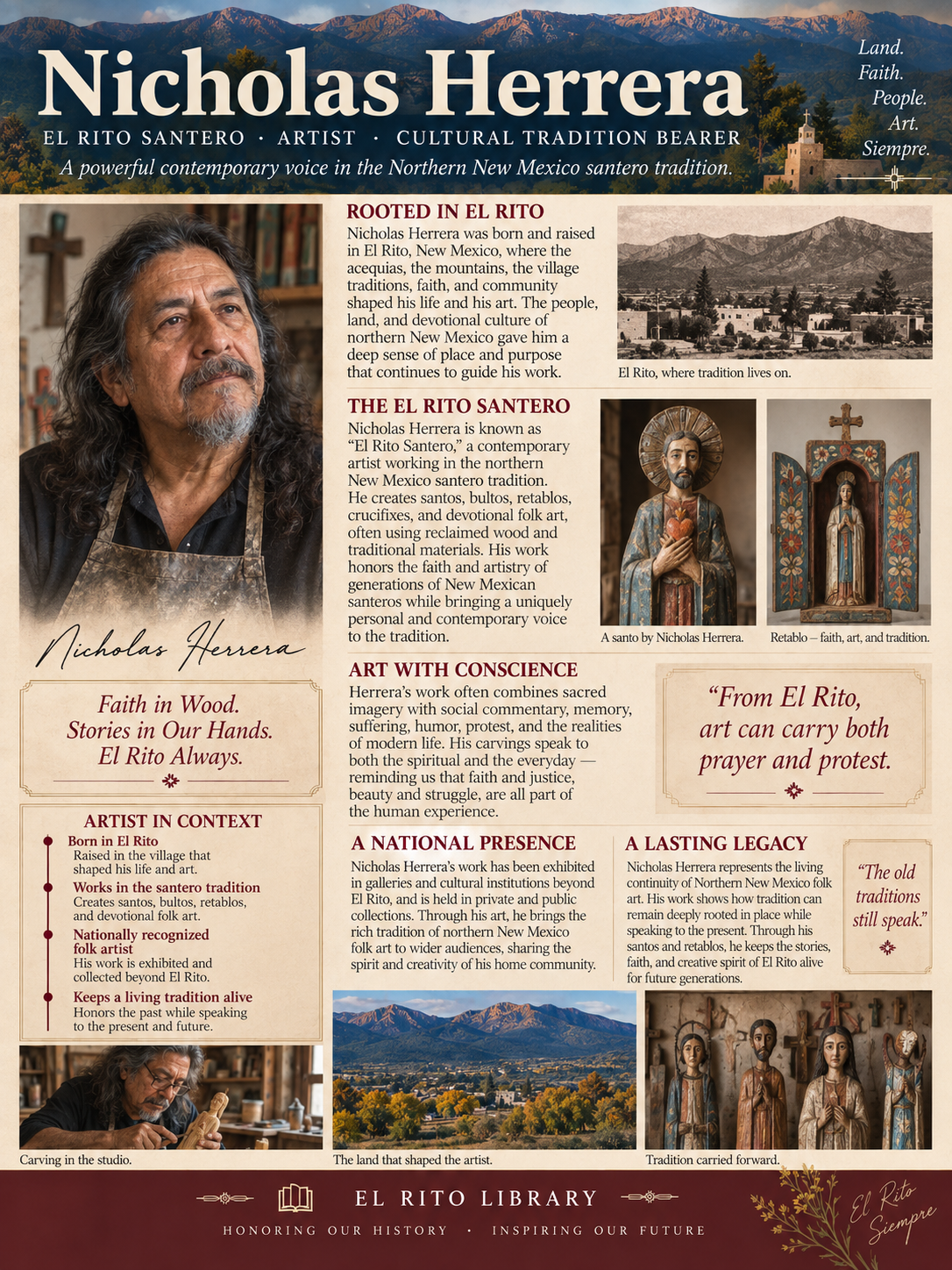
Nicholas Herrera is one of the most nationally recognized artists to emerge from El Rito. His importance, however, cannot be explained simply by saying that his work has entered major museums. Herrera's art is unusually inseparable from the village itself. El Rito's Catholic traditions, Penitente heritage, mountain ranches, lowriders, junked automobiles, acequias, poverty, family histories, violence, humor and religious faith all enter his work. He has taken the centuries-old northern New Mexico tradition of thesantero—the maker of devotional images of saints—and stretched it into an intensely personal form of contemporary folk art.
The Smithsonian American Art Museum identifies him simply but significantly as “Nicholas Herrera, born El Rito, NM 1964.” Today he is widely known as El Rito Santero—the Saint Maker of El Rito.
Born into El Rito
Nicholas Herrera was born in El Rito on July 11, 1964, the youngest of six children of Pedro and Celia Herrera. The Harwood Museum's extensive biographical study of Herrera records that he grew up surrounded by a family whose history was deeply intertwined with northern New Mexico.
His father, Pedro, worked as a janitor at Los Alamos National Laboratory and was also a skilled furniture maker. Nicholas remembered going with his father to junkyards and searching through discarded machinery and automobile parts. That childhood experience would later become remarkably important: rusted metal, hubcaps, old wheels, car bodies and other discarded objects became part of Herrera's artistic vocabulary.
His mother, Celia, exerted an equally important influence. She cleaned houses for artists living around El Rito, and Nicholas sometimes accompanied her. Some of those artists gave the boy leftover drawing paper, brushes and paint. Celia encouraged him to paint rocks, make things from discarded materials and use his hands creatively. Herrera later remembered that one of the artists introduced him to exhibitions in Taos, while his mother took him to see Georgia O'Keeffe when he was approximately twelve years old.
This is an important part of the Herrera story. He did not grow up in an art academy. His education came from El Rito itself—from family craftsmen, church imagery, discarded materials, working people and the artists whom he encountered through his mother's work.
An older Herrera artistic tradition
Nicholas also inherited a remarkable family connection to New Mexico religious art.
His relative José Inés Herrera, active during the late nineteenth and early twentieth centuries, became known as the Santero de la Muerte—the Saint Maker of Death. José Inés specialized in the skeletal figures and death carts historically associated with the Penitente religious tradition of northern New Mexico and southern Colorado.
The connection is particularly tangible because José Inés once occupied a family cabin in Potrero Canyon above El Rito. Nicholas visited that country as a child with his father. Later, after the birth of his daughter Elena, Herrera took her to the old cabin so that, as he described it, she could “meet” her ancestors.
Herrera has repeatedly said that seeing photographs of José Inés Herrera's work helped him understand his own desire to carve. He considered the impulse something almost inherited.
The important point is that Nicholas did not simply decide one day to imitate nineteenth-century santos. He discovered that the objects he wanted to make belonged to a cultural and family vocabulary that had existed around him for generations.
His family has been traced back for centuries, according to Herrera. They include:
| Person or ancestral connection | Published account | What remains unverified |
|---|---|---|
| Juan de la Cruz | The Harwood guide identifies him as Nicholas’s great-great-grandfather, a potato farmer in Potrero Canyon who operated a feed store in El Rito during winter. | His full identity, dates, spouse, and the intervening generations. |
| Rosa “Vilpando” | The same guide names her as an ancestor associated with Comanche captivity in eighteenth-century Taos. | Her precise identity and the parent-to-child chain connecting her to Nicholas. |
| Abiquiú genízaro ancestry | Harwood reports this ancestry through Pedro Herrera and describes a possible Jicarilla Apache connection as tentative. | The named ancestors and records supporting that particular connection. |
The Rosa connection has quite a bit of history behind it, and we believe her actual identity was, María Rosa Villalpando.
María Rosa Villalpando was herself a captive of Comanche raiders. She is very likely the woman called “Rosa Vilpando” in Nicholas Herrera’s Harwood Museum biography: the name, location, and circumstances closely match.
Historical research establishes the following:
- On August 4, 1760, Comanche raiders attacked the Villalpando compound at Ranchos de Taos. María Rosa was captured; her husband and mother were killed. Her young son, José Julián Jáquez, survived and remained in New Mexico.
- During her captivity, she had another son, Antoine. Historian Frances Levine identifies his father as a Comanche man. María Rosa and her child were subsequently sold to Pawnee people and then purchased by the French trader Jean Baptiste Salé dit Lajoie, who became her husband.
- By 1770, she had established a household in St. Louis. Her marriage contract with Salé dit Lajoie survives. She remained in St. Louis and died there on July 27, 1830.
There is documentary evidence behind this account. In a June 26, 1768 letter, French traders described an unnamed Spanish woman captured approximately eight years earlier, forced into a relationship with a Comanche leader, and later sold with her son. Levine identifies this woman as María Rosa, while acknowledging that the letter does not name her. Levine’s archival citation places the correspondence in the Archivo General de Indias, Papers of Cuba 109–1171, with microfilm at the Missouri Historical Society.
The July 3, 1770 marriage contract provides a further connection: it identifies Antoine as María Rosa’s child born during captivity. Levine discusses and reproduces the contract in “María Rosa Villalpando: From Captive to Creole” You can read that account below:
The child who carved everything
School was difficult for Herrera. He has spoken openly about dyslexia and being placed in special education. Conventional academic success eluded him, but his hands and imagination were constantly active. His school desk reportedly accumulated carved images—outlaws, guns, hearts and “wanted” signs.
He carved animals, snakes, boats and other small objects.
One especially revealing incident occurred when Herrera was about fifteen. His brother discovered a collection of Nicholas's carvings, took them to Canyon Road in Santa Fe and reportedly sold them for $250. The event offered the teenager an early indication that other people considered what he made valuable.
Still, Herrera did not immediately imagine himself becoming a professional artist.
After high school, he worked as a Forest Service firefighter and later on a road crew at Los Alamos. The life that followed was turbulent. Herrera himself has been unusually candid about alcohol, drugs, weapons, fighting, dangerous driving and repeated encounters with law enforcement during his youth.
Those experiences would eventually become material for his art rather than something he tried to erase from his biography.
The accident that changed his life
The defining event in Herrera's story occurred in 1990, when he was twenty-six.
After drinking and driving on a winter night, Herrera crashed his Yugo into another vehicle. His car was destroyed. He suffered a concussion, serious back injuries and broken ribs and was left unconscious in a snowbank. A long-haired stranger reportedly remained with him, covered him with a blanket and stayed until help arrived. Herrera later interpreted the unidentified man's intervention as something more than chance—possibly a manifestation of Christ or an angel.
During his hospitalization, Herrera experienced what he describes as a near-death vision.
In that vision, Christ and La Muerte struggled over him. The skeletal Death figure resembled one carved by José Inés Herrera.
The Smithsonian records Herrera's belief that this experience convinced him that God had spared him for a reason: he was supposed to become a santero.
It became the dividing line in his life.
There was Nicholas Herrera before the wreck.
And there was Nicholas Herrera after it.
Some popular accounts date the wreck to 1992, but the Smithsonian, Harwood Museum and the recent museum exhibition research consistently place it in 1990. For the El Rito History Project, I would use 1990 unless primary documentation establishes otherwise.
From jail drawings to the gallery
One of the more extraordinary episodes in Herrera's early career came out of precisely the life he was trying to leave behind.
According to the Harwood Museum's research, during one period in jail he made drawings on sheets of paper and exchanged some with a guard for cigarettes. After Herrera was released, the guard told him that his wife was associated with Fuller Lodge and wanted to exhibit Herrera's work.
That resulted in Herrera's first art exhibition.
The story almost perfectly anticipates the contradiction that would characterize his art: incarceration produces drawings; the drawings produce an exhibition; a troubled past becomes creative material.
Herrera began exhibiting more seriously during the late 1980s and 1990s. He was accepted into Santa Fe's Traditional Spanish Market in 1988, but eventually withdrew in 1997. The Harwood Museum explains that he increasingly resisted the restrictive definitions of what Spanish Colonial devotional art was supposed to look like.
Herrera could make a traditional santo.
He simply refused to believe that tradition required him to make only what previous generations had made.
A santero—but not a conventional one
Herrera works in the familiar forms of northern New Mexico devotional art. A retablo is generally a painted devotional image on a flat wooden panel. A bulto is a three-dimensional carved religious figure.
Herrera makes both.
He carves Christ, the Virgin of Guadalupe, San Isidro, saints, crucifixes and La Muerte.
Then Herrera does something that makes the work unmistakably his.
Cars appear.
Motorcycles appear.
Police cars appear.
Beer bottles, guns, jail cells, nuclear symbolism, barbed wire, hubcaps and scrap metal enter the compositions.
Jesus may find himself inside a police car.
The Holy Family may participate in lowrider culture.
Death may ride agricultural machinery.
And yet Herrera insists that these pieces remain connected to genuine religious experience.
This mixture of sacred devotion, satire and contemporary life has made him difficult to categorize—and enormously interesting to museums.
Protect and Serve
One of Herrera's most important works is Protect and Serve, created in 1994.
The sculpture depicts Christ in the back of a police car driven by two officers. Herrera connected Christ's arrest and persecution to contemporary experiences of racial prejudice and abuses of authority. The work also incorporates lowrider imagery and religious symbolism.
In 1997 the Smithsonian American Art Museum acquired the piece for its permanent collection.
That was a major threshold in Herrera's career: a work born from one man's experiences with police and authority in rural northern New Mexico entered the national collection in Washington.
The Smithsonian also holds Herrera's Dance Hall, Bar, and Lowrider, dated 1995, another complex representation of religion, vehicles, rural landscapes and northern New Mexican life.
Lowriders become sacred objects
Herrera's fascination with automobiles began with his father.
In 1990 he discovered the remains of a 1939 Chevrolet coupe in a ditch. It was riddled with bullet holes and filled with dirt. Herrera and friends restored it. Eventually it became an almost theatrical black automobile with red, coffin-like upholstery—part car, part sculpture, part extension of Herrera himself.
Automobiles subsequently became recurring characters in his artwork.
Perhaps the best-known example is Lowrider Nativity (2005). Instead of treating biblical figures as inhabitants of a remote European or Middle Eastern past, Herrera brings the story directly into northern New Mexico's car culture. Mary, Joseph and the Magi inhabit a world of customized vehicles and motorcycles.
It is humorous without being merely a joke.
Herrera is effectively saying that sacred history belongs in El Rito, Española, Chimayó and northern New Mexico just as surely as it belongs in Renaissance paintings.
Painting El Rito
For the El Rito History Project, Herrera's paintings of the village may ultimately be just as important as his santos.
He repeatedly paints El Rito from an elevated viewpoint, almost as though the viewer were standing on a hillside looking down.
The scenes teem with activity.
People attend church.
Cars travel the roads.
Animals move among buildings.
Neighbors gather.
Children skate.
People dance.
Religious ceremonies and village celebrations unfold beneath the familiar surrounding hills.
The Harwood Museum describes these paintings as representations of village life filled with “simple realism, nostalgic atmosphere, vibrant color, and bustling activity.”
They are something more than folk paintings.
They constitute a kind of visual social history of El Rito.
Individual residents sometimes appear. Churches and the morada recur. Automobiles share space with horses, religious figures and landscapes. Ordinary village life becomes worthy of historical painting.
This makes Herrera especially relevant to what we are doing with the El Rito History Project.
Other artists have painted northern New Mexico.
Nicholas Herrera has painted El Rito from inside El Rito.
Wheel of Life
A key work for understanding Herrera personally is his 2003 Wheel of Life.
It functions almost like a carved autobiography.
The work begins with his parents, Celia and Pedro, and his birth. It passes through childhood, difficulty in school, family tensions, automobile culture, his involvement with the Penitente Brotherhood, addiction, arrests and imprisonment, and finally the automobile accident that transformed his life.
The wheel then moves toward Herrera's life as an artist and father, including his daughter Elena.
Herrera has never constructed an artificial biography in which the successful artist emerges fully formed.
He puts the failures in the art too.
That is crucial to understanding him.
His drinking, arrests, anger, faith, family, love of machines and brush with death are not merely background information about the artist.
They are the subject matter.
Faith and the Penitente tradition
Herrera has also been involved with the Penitente Brotherhood, following family connections to that northern New Mexico religious tradition. His art repeatedly invokes the imagery of Christ's Passion, death, suffering, redemption and resurrection.
But Herrera's spirituality is rarely sentimental.
Death is always nearby.
So is humor.
So is sin.
So is redemption.
That combination is deeply northern New Mexican in character. The sacred and ordinary are not neatly separated. A saint can share visual space with a lowrider; La Muerte can appear beside a tractor; religious symbolism can address police brutality or alcoholism.
The result is devotional art capable of commenting on the present.
National recognition
Herrera's work gradually moved far beyond Rio Arriba County. His art has been exhibited in places including New York, Chicago and Paris, and his works have entered major collections including the Smithsonian American Art Museum, American Folk Art Museum and Museum of International Folk Art. Other institutions have also collected his work.
He received the National Folk Art Society's National Award of Distinction in 2006 and, in 2016, the New Mexico Governor's Award for Excellence in the Arts.
A major scholarly treatment appeared in 2003 when Barbe Awalt and Paul Rhetts published Nicholas Herrera: Visiones de mi Corazón / Visions of My Heart, containing hundreds of examples of his artwork and substantial discussion of his life and artistic development.
The Harwood exhibition
A particularly significant moment came in 2024.
From September 21, 2024, through June 1, 2025, the Harwood Museum of Art in Taos mounted Nicholas Herrera: El Rito Santero.
Remarkably, despite decades of exhibitions and national museum acquisitions, it was Herrera's first solo museum exhibition. Curators Nicole Dial-Kay and Kate Miller approached the exhibition not simply as a collection of santos but as an exploration of Herrera's family, village, spirituality, politics, personal struggles and relationship with El Rito.
The museum went so far as to describe Herrera as one of America's important contemporary folk artists.
The timing matters for our history project. It means there is now a recent, professionally researched museum biography specifically connecting Herrera's work to El Rito, Potrero Canyon and his Herrera family history.
Still the village artist
Success did not remove Herrera from El Rito.
He continued to live and work on his family's land, using local wood, discarded machinery and other materials. Harwood deliberately described him as a “village artist.”
As of 2026 his work remains active rather than merely historical. Recent and scheduled exhibitions through EVOKE Contemporary include Madre del Mundo, Ánimas del Camino (Spirits of the Road) and Cruisin' New Mexico, while his work also appeared in the Millicent Rogers Museum exhibition La Acequia, Nuestra Madre.
That is an important ending for his biography because Nicholas Herrera's story is not finished.
He is a living El Rito artist.
Why Nicholas Herrera matters to El Rito
For our project, I would resist portraying Herrera merely as “a famous artist who happens to come from El Rito.”
That misses what makes him important.
El Rito is actually one of the principal subjects of his life's work.
His saints belong to northern New Mexico. His cars come from northern New Mexico. His humor comes from the village. His religious imagery connects with the Penitente heritage. His discarded materials evoke the resourcefulness of rural communities. His landscapes record the surrounding hills. His paintings preserve local ceremonies and people. Even the contradictions in his work—Catholic devotion beside rebellion, death beside comedy, tradition beside lowrider culture—reflect the complicated cultural history of Rio Arriba County.