El Rito in the 1960s
When the Outside World Came Up the Road
There may be no decade in modern El Rito history quite like the 1960s.
At the beginning of the decade, El Rito remained recognizably the old northern New Mexico village it had been for generations. Families tended irrigated fields and gardens. Cattle and sheep still tied households to the mountains. The acequias carried water through property divided and inherited over generations. Spanish could be heard as naturally as English. San Juan Nepomuceno remained a spiritual landmark, Martin's Store was part of the everyday commercial world, and up the road stood the institution almost everyone still knew simply as La Normal.
By the end of the decade, almost everything surrounding that world seemed to be changing.
College students were digging into the remains of an ancient Pueblo settlement just outside the village. The old Normal School was preparing to graduate its final high-school class. Young men with long hair, beards and battered vehicles were appearing on northern New Mexico roads. Photographers, poets and self-described "new settlers" were moving into old adobe houses. The national argument over Vietnam was underway. The struggle over Hispanic land grants erupted into armed confrontation at Tierra Amarilla. And on the Fourth of July in 1968, one of the most recognizable buses of the American counterculture rolled directly through an El Rito parade.
For a village of only a few hundred people, the 1960s arrived with extraordinary force.
Yet El Rito did not simply become part of "the Sixties."
The Sixties came to El Rito.
And when they arrived, they encountered a community that already possessed nearly two centuries of its own history.
Before the Hippies Came
It would be a mistake to begin the story of El Rito in the 1960s with communes and psychedelic buses.
The decade began with children walking into classrooms, families going to Mass, ranchers worrying about water and grazing, people visiting the store, and students gathering on the campus of Northern New Mexico State School.
The school remained one of the defining institutions of the village.
Founded in 1909 as the Spanish American Normal School, it had evolved repeatedly. By the beginning of the 1960s it was serving both secondary students and an expanding postsecondary mission. In 1961, two-year programs in business education, general studies and selected vocational fields were introduced.
For generations of northern New Mexico families, however, institutional names mattered less than memory.
It was still the Normal.
Students arrived from communities scattered across northern New Mexico. Some boarded there. Teachers and employees lived in or around El Rito. Athletic contests, graduations, dances and school activities brought people together.
And for several remarkable years, tiny El Rito became one of the dominant names in New Mexico distance running.
The Boy Who Could Run
Beginning in 1961, El Rito student Gerry Garcia won the state individual cross-country championship five consecutive times—1961, 1962, 1963, 1964 and 1965.
No New Mexico high-school runner has surpassed those five individual titles.
El Rito also won the Class B team championship for three consecutive years, from 1961 through 1963. The official New Mexico Activities Association records preserve an extraordinary sequence: Garcia winning in 11:06 in 1961, 10:57 in 1962 and 1963, 9:32 in 1964 and 9:41 in 1965.
That deserves a place in the story of the decade.
Before El Rito became known to outsiders as a counterculture destination, a boy from the village was running across New Mexico and making the name El Rito synonymous with winning.
For local families, that was the Sixties too.
Something Much Older Was Being Unearthed
While young people were running across the Normal School campus, another group of students was arriving several miles down the valley carrying shovels, notebooks and surveying equipment.
They came to study Sapawe.
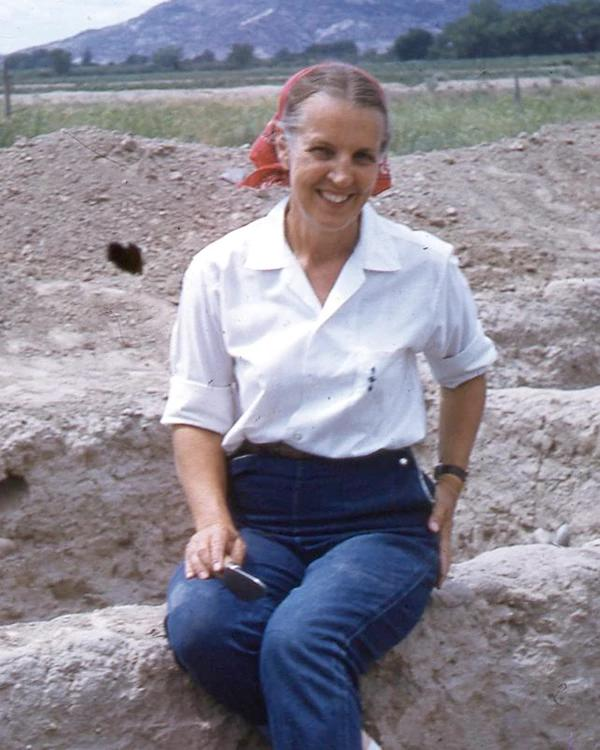
The enormous ancestral Tewa settlement beside El Rito Creek had been known locally for generations. During the 1960s, however, archaeologist Florence Hawley Ellis and University of New Mexico field-school students began a sustained investigation of the site.
Excavations occurred during several seasons between 1963 and 1969. Sapawe was—and remains—one of the largest Pueblo IV settlements in New Mexico, containing multiple plazas and thousands of rooms. Later archaeological reviews describe the UNM work of the 1960s as the fundamental modern investigation of the site.
There was an almost remarkable symmetry to what was happening.
At one end of El Rito, a school founded to prepare northern New Mexico for the twentieth century was changing its mission.
Down the valley, archaeologists were digging into a community that had flourished centuries before Spanish settlers created El Rito.
And between the two stood the living village itself.
The 1960s therefore forced El Rito to look in two directions at once:
far backward into its Indigenous past and rapidly forward into an uncertain future.
1966: The New Settlers Arrive
Then another kind of excavation began—not into the ground, but into American society.
By the middle of the decade, young Americans were questioning nearly every institution their parents' generation had accepted: war, consumerism, organized religion, corporate employment, suburban life, sexual conventions and political authority.
Some went to San Francisco.
Some went to New York.
Some went to communes.
And a surprising number went to northern New Mexico.
Photographer Irwin Klein reached El Rito in 1966. His work would eventually become one of the most important visual records of the northern New Mexico counterculture.
The University of Nebraska Press describes the people Klein encountered as "new settlers"—young urban and suburban Americans who moved into small Nuevomexicano communities or established alternative settlements in the countryside. His photographs documented everyday life rather than simply the flamboyant mythology of the hippie movement.
El Rito was important enough to the story that the scholarly volume devoted to Klein's photographs contains an entire chapter titled:
“El Rito and the Power of Place in Sixties America.”
That is an extraordinary distinction for a village its size.
Klein's surviving photographs include El Rito-area residents and newcomers living in adobe houses, working outdoors and attempting a stripped-down, back-to-the-land existence. The Palace of the Governors Photo Archives now preserves a number of his vintage prints, including an image of Steve Samuels, Max Finstein and Tom Law carrying a bell at the El Rito Campground.
The photographs matter because they strip away some of the romantic mythology.
Northern New Mexico was beautiful.
It was also hard.
Old houses needed constant work. Winters were cold. Money was scarce. Farming required knowledge most newcomers did not possess. Water could not simply be taken because it flowed past your land; acequia communities had rules, traditions and obligations.
New Mexico historian Daniel Kosharek has emphasized that Klein's photographs reveal not simply idealism but poverty, hardship and the contradictions of the counterculture experiment.
For the newcomers, El Rito sometimes seemed like an escape from modern America.
For families who had been living there for generations, however, El Rito was not an escape.
It was home.
That distinction is essential.
Two Very Different Ideas About the Land
The meeting between long-established Hispano families and the new settlers created one of the most fascinating elements of El Rito's 1960s history.
The newcomers often spoke enthusiastically of “going back to the land.”
El Rito families could reasonably have wondered:
Back from where?
They had never left it.
For generations, village families had depended upon irrigated gardens, livestock, firewood, grazing, forest products and the community obligations surrounding water.
The newcomers sometimes imagined subsistence living as an ideological alternative to consumer society.
For El Rito families, many of those practices were not ideology.
They were inheritance.
This does not mean the two communities were necessarily enemies. Klein's photographs record interactions between longtime residents and newcomers, and some of the outsiders eventually became lasting members of northern New Mexico communities.
But their reasons for being there were profoundly different.
One group was attempting to recover a way of life.
The other had spent generations trying to preserve one.
The Land Question Turns Political
At exactly the moment outsiders were arriving to celebrate northern New Mexico's open spaces, many Hispano families were asking a much older and angrier question:
Who actually owned the land?
By the 1960s, disputes over old Spanish and Mexican community land grants, grazing permits, timber rights and Forest Service management had become politically explosive.
Much of what eventually became the El Rito Ranger District of the Carson National Forest had historically been community-grant territory used by nearby Hispano villages for grazing and other resources. The National Park Service has specifically noted the deep historical dependence of northern New Mexico stockmen upon those lands.
The Forest Service itself recognizes that communities surrounding the El Rito district have longstanding cultural and economic connections with grazing, fuelwood gathering and other forest uses.
During the middle 1960s, those relationships became increasingly contentious.
Reies López Tijerina and the Alianza Federal de Mercedes demanded reconsideration of historic land-grant losses. In October 1966, Alianza members occupied the Echo Amphitheater area of the Carson National Forest as part of that campaign. A contemporary Forest Service history describes the confrontation as a dramatic challenge to federal authority in northern New Mexico.
The controversy was not remote from El Rito.
Forest Service records and subsequent historical research show that officials administering the northern forests were simultaneously confronting disputes over grazing restrictions, timber management and the future of programs such as the Vallecitos Federal Sustained Yield Unit. By early 1967, officials were explicitly considering how land-grant activism might affect Forest Service decisions.
Then came June 5, 1967.
Tierra Amarilla Reaches El Rito
The armed raid on the Rio Arriba County courthouse at Tierra Amarilla became one of the defining moments in modern northern New Mexico history.
Tijerina's followers went to the courthouse attempting to make a citizen's arrest of District Attorney Alfonso Sánchez. Gunfire erupted. Two law-enforcement officers were wounded. Hostages were taken. The raiders fled, and Governor David Cargo mobilized an enormous search involving police and National Guard forces.
The entire region suddenly seemed under military scrutiny.
And the story came directly into El Rito.
One of the principal participants, Baltazar Martinez, hid for more than a week near his mother's El Rito home while authorities searched for him. Contemporary accounts later reported that he periodically approached the house for food. His mother ultimately supplied information leading to his capture, reportedly because she feared that he otherwise might be killed.
Imagine El Rito during those days.
Helicopters and aircraft were part of the wider search.
Roads were watched.
Rumors traveled from house to house.
People knew one another.
Families had connections extending from El Rito to Canjilón, Vallecitos, Abiquiú and Tierra Amarilla.
National reporters descended upon Rio Arriba County.
For a village accustomed to determining its affairs largely within its own network of families and neighbors, the outside world had arrived in another form.
Not as hippies this time.
As police, soldiers, journalists and politicians.
The dispute that lay beneath the raid—land—was one El Rito understood intimately.
1968: Then Came the Bus
And then, almost impossibly, came one of the strangest surviving photographs in El Rito history.
July 4, 1968.
El Rito was holding its Independence Day parade.
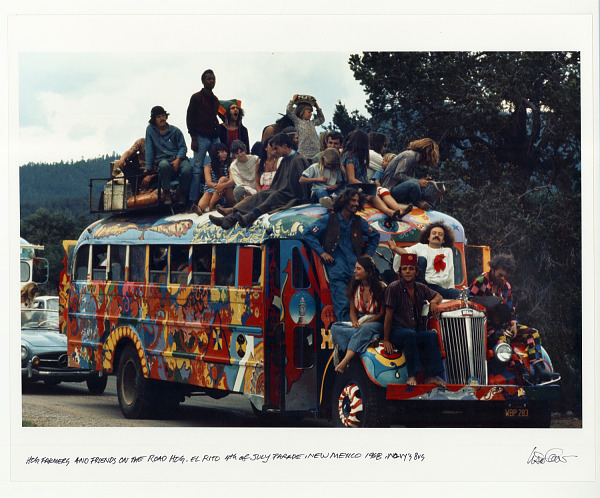
Into it came a wildly painted bus covered with psychedelic designs.
Riding on it were members and friends of the Hog Farm, the countercultural collective associated with Hugh Romney—the man who would soon become universally known as Wavy Gravy.
Photographer Lisa Law was there.
She raised her camera.
And because she did, we can still see the moment.
The Smithsonian National Museum of American History preserves several of Law's photographs made in El Rito that day. One shows Hog Farmers and friends marching through the village. Another records their brilliantly painted “Road Hog” bus loaded with people. Another shows Victor Maymudes walking beside it.
The images are remarkable.
Not because they merely show hippies.
They show hippies in El Rito.
Adobe walls stand behind them.
Local people and children mingle within the scene.
Traditional Fourth of July celebration and American counterculture occupy the same street.
No recreation is necessary.
No artist has to imagine the encounter.
It happened, and Lisa Law photographed it.
There is something wonderfully complicated about that photograph.
July Fourth traditionally celebrated national identity.
Many members of the counterculture were fiercely critical of American government policy, particularly the Vietnam War.
Meanwhile, northern New Mexico land-grant activists were arguing that the United States had failed to honor obligations dating from the Treaty of Guadalupe Hidalgo.
And all of these American identities briefly occupied the same road in El Rito.
The ranch family.
The student.
The Catholic parishioner.
The land-grant activist.
The Forest Service employee.
The hippie.
The child watching the parade.
The photographer recording it all.
That photograph may be one of the finest visual metaphors we have for El Rito in the 1960s.
Meanwhile, Ordinary Life Continued
There is a danger in writing history backward.
Knowing about Tijerina, hippies and Wavy Gravy can make it seem as though every day in El Rito was filled with political upheaval.
It wasn't.
People still had to irrigate.
Animals still escaped fences.
Wood still had to be cut.
Children still went to school.
Cars broke down.
Families married, buried relatives and baptized children.
People stopped at the store.
The church bell still rang.
Snow still closed roads.
Spring runoff still determined how much water might reach a field.
That ordinary life is perhaps the most important part of the story.
El Rito did not discard its old identity because outsiders discovered it.
Instead, for several years, multiple versions of America existed beside one another in the same small valley.
1969: The End of an Era
The decade ended with a change that may have affected El Rito more deeply than any psychedelic bus.
In 1969, the final high-school class graduated from the El Rito institution.
The high-school curriculum was transferred to the public-school system as the El Rito campus increasingly concentrated on technical and vocational education. Northern New Mexico College's institutional history places the final senior graduating class in 1969—exactly sixty years after the school opened in 1909.
Think about what that meant.
For sixty years, generations of young people had come of age at the Normal.
Parents had attended.
Then their children.
Perhaps their grandchildren.
School photographs had accumulated.
Athletic rivalries had formed.
Teachers had become community figures.
Graduation had been woven into village identity.
Then the last seniors walked across the stage.
The buildings remained.
Education remained.
But something had ended.
The following decade would move the institution increasingly toward Española.
The center of gravity was beginning to shift away from El Rito.
A Village Between Two Americas
By December 1969, El Rito must have looked outward upon a very different country from the one it had known in January 1960.
John F. Kennedy had been elected and assassinated.
The Vietnam War had expanded.
The civil-rights movement had transformed American political life.
The Chicano movement had grown.
Tijerina had made northern New Mexico's land grants a national issue.
Young Americans had rejected conventional suburban life and begun experimenting with communes.
Woodstock had taken place.
And some of the people who helped make that strange new counterculture famous had already marched through El Rito's Fourth of July parade.
Yet the acequias still carried water.
San Juan Nepomuceno still stood.
Families with names embedded in El Rito's history still lived on land their parents and grandparents had known.
That may be the central meaning of the decade.
El Rito did not cease being El Rito.
Instead, America changed around it.
And for several extraordinary years, the little village became a place where the country's competing ideas about land, freedom, community, tradition and the future collided in full view.
The Hispano rancher and the hippie newcomer sometimes wanted surprisingly similar things: independence, land, community and freedom from distant authority.
But they arrived at those desires through completely different histories.
One was looking for something America had lost.
The other was fighting to hold onto something America had nearly taken away.
And perhaps nowhere is that paradox captured better than in Lisa Law's photograph from July 4, 1968:
A psychedelic bus rolling through an old Hispano village beneath the New Mexico sun.
Children walking beside it.
Old adobe behind it.
The mountains beyond.
For a moment, the American 1960s passed directly through El Rito.
And El Rito was never quite the same afterward.