
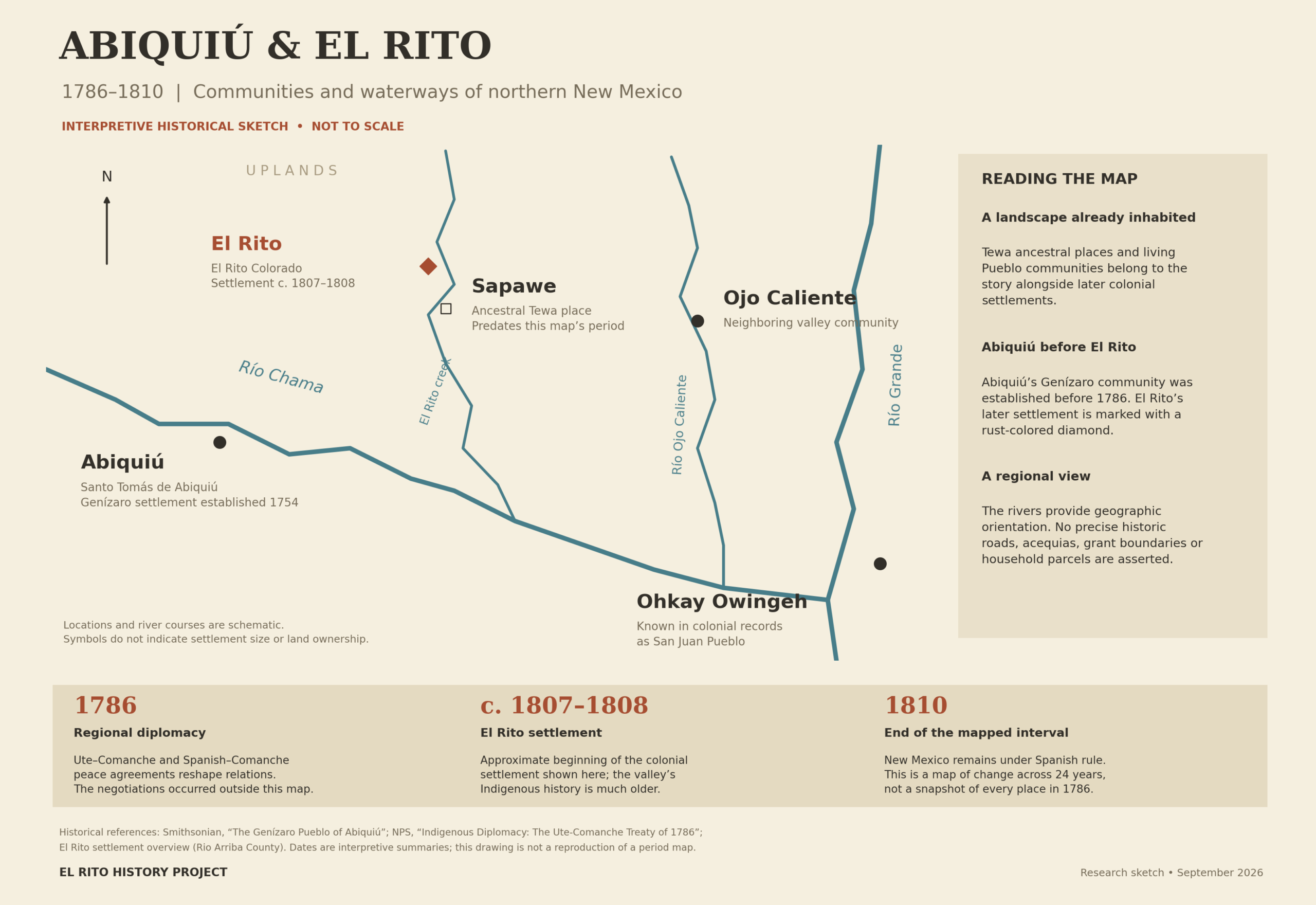
Known by two names, this pueblo survives today.
The Tewa inhabitants had left Sapawe long before the area fell under Spanish Control
Land in the El Rito area began being sold to settlers around 1808
Ojo Caliente was settled sporadically as early as 1735 by a mixture of genizaros, detribalized Native Americans (or Indians) mostly descended from slaves, and Hispanics.
The scene of witchcraft trials: Five decades after the Salem witchcraft trials, where over 200 people were accused of witchcraft in colonial Massachusets, there was an outbreak of witchcraft in Abiquiu, New Mexico.
INTERACTIVE MAP ABOVE
“By the beginning of the nineteenth century, lands along El Rito Colorado were associated with Joaquín García, whose family may have had claims in the valley dating back several generations. Later El Rito residents remembered García as the recipient of a Spanish grant around 1780. Although the original grant papers have not survived, documentary evidence shows that by June 1808 García-associated lands were being divided and sold to settlers from Abiquiú, Ojo Caliente, Taos and other northern New Mexico communities. These transactions mark the clearest documentary beginning of the permanent Hispano village that became modern El Rito.”
The clearest published source for the specific 1807–June 1808 statement is a U.S. Forest Service historical study of irrigation and settlement in the Rio Grande Valley. It says:
“About 1807 Joaquin Garcia acquired land at El Rito”
and adds that portions were being sold as early as June 1808 to people from Abiquiú, Ojo Caliente, Taos, Las Casas de Riaño, and Cañón del Río de Chama. Significantly, the authors inserted the qualification that García acquired the land “apparently by a grant from Governor Alencaster.” They cited the nineteenth-century U.S. Surveyor General investigation that became Report/Case 151.
That word “apparently” matters enormously. It means the historian was reconstructing what probably occurred from later evidence—not quoting a surviving 1807 grant signed by the governor.
The chronology is actually more complicated
| Date | What the evidence says | How confident we should be |
|---|---|---|
| 1735 | Juan Esteban García de Noriega was associated with an earlier grant in the Rito Colorado/El Rito area. | Strong evidence of an earlier García-family claim; relationship to the later Town of El Rito claim remains complicated. |
| after 1751 | Historical archaeologists Frances Leon Quintana and David Snow believed García may have established or occupied El Rancho de Santa Bárbara del Rito Colorado in what became the El Rito area. | Scholarly reconstruction rather than an unquestioned documentary fact. |
| c. 1780 | El Rito resident Jesús María Vigil later testified that his great-grandfather Joaquín García received the grant about 1780. The GAO subsequently listed the Town of El Rito grant under Joaquín García with the date 1780. | Important nineteenth-century family/community testimony, but original title papers were already lost. |
| c. 1807 | A later Forest Service historical synthesis concluded García acquired the land around 1807, apparently from Governor Joaquín del Real Alencaster. | Plausible reconstruction, but no surviving García-Alencaster grant has yet been located. |
| June 1808 | García was apparently already selling portions of the property to incoming settlers. | One of the strongest dates because later investigators saw deeds for individual El Rito tracts dating from 1808 onward. |
| 1808–1843 | Numerous deeds for individual properties were presented during the later Surveyor General investigation. | Very strong documentary evidence that individual landholding and transfer were established. |
| 1825 onward | A later El Rito landowner could trace deeds and possession back to at least 1825 in Grant v. Jaramillo. | Direct evidence of longstanding chains of possession attributed to García's title. |
| 1883 | Jesús María Vigil petitioned the U.S. Surveyor General on behalf of El Rito residents to recognize García's grant. | Well documented. |
| 1890s | Federal investigators accepted that García's heirs had equitable claims to homes and irrigated lands but did not find adequate legal proof of title to the entire claimed grant. | Well documented. |
| 1898 | Heir Tomasa Tenorio de Quintana stopped prosecuting Court of Private Land Claims Case 224. | Well documented. |
This is therefore not simply an “1807 land grant.” It is a story stretching from an eighteenth-century García-family claim through the creation of a permanent agricultural settlement around 1808 and finally into a century-long struggle over what that older title meant under United States law.
1. Before Joaquín: the García family was already connected with Rito Colorado
The García connection apparently predates Joaquín by decades.
Historical archaeologists Frances Leon Quintana and David H. Snow, in their study Historical Archaeology of the Rito Colorado Valley, New Mexico, examined an earlier claim involving Juan Esteban García de Noriega. A secondary reconstruction based on their work says Juan Esteban received a grant in 1735 covering land associated with the later El Rito area. Problems arose over the required occupation of the property, and the legal status of the grant became uncertain. Quintana and Snow nevertheless considered it reasonably likely that after about 1751 García occupied a place identified as El Rancho de Santa Bárbara del Rito Colorado in the vicinity of modern El Rito.
A federal-era compilation of New Mexico land claims also separately lists “Juan Esteban Garcia de Noriega (El Rito)” with the year 1735. That does not prove the modern village originated in 1735, but it confirms that the García family had a much earlier documentary association with the Rito Colorado country.
This is important because it creates another possibility: Joaquín García's later claim may have represented a continuation, revival, inheritance, regrant, or redistribution of an older García-family interest rather than an entirely new acquisition created in 1807.
2. Who was Joaquín García?
This remains one of the most intriguing unanswered questions.
Juan Esteban García de Noriega had a son named José Joaquín García de Noriega, baptized at Santa Cruz on March 20, 1735. Genealogical material based on Fray Angélico Chávez's Origins of New Mexico Families identifies him as a son of Juan Esteban and Luisa Gómez Luján and records his marriage to María Concepción García de la Mora in 1761.
More importantly, independent documentary transcriptions show a Joaquín García de Noriega acting as a notary at Santa Cruz in 1779 and again in April 1780. Thus a man of exactly that name was active in the right region at almost precisely the date when later El Rito tradition said Joaquín received the grant.
That is tantalizing.
Joaquín García, whom nineteenth-century El Rito residents remembered as an ancestor and original grantee, may have belonged to the García de Noriega family that had claimed Rito Colorado lands since the 1730s.
3. Where does the 1780 date come from?
This is where the federal land-claim record becomes critical.
On October 22, 1883, Jesús María Vigil, identified as a resident of El Rito, approached U.S. Surveyor General Henry M. Atkinson for himself and other interested residents. Vigil said a grant had been given to his great-grandfather Joaquín García “in about 1780.” Historian J. J. Bowden's transcription describes the claimed property as lying on both sides of the El Rito River.
The problem was fundamental:
the original grant documents could not be produced.
The later New Mexico Land Grant Council/Legal Aid examination of the case states plainly that “the documents for this grant were lost.” Vigil therefore relied on several different kinds of evidence: long occupation, the existence of established communities on the claimed land, family and community oral tradition, and old deeds.
The federal GAO eventually placed the claim in its historical inventory as:
Town of El Rito (Joaquín García) — 1780 — Río Arriba County.
But this needs interpretation. The GAO's “1780” does not mean that it found an original 1780 royal or gubernatorial grant bearing Joaquín García's name. The surviving investigation itself says the original papers were lost. The date reflects the historical claim transmitted through the nineteenth-century proceedings.
4. Then why does another source say 1807?
The Forest Service history places García's acquisition“about 1807,” apparently through Governor Alencaster, but it provides no surviving García petition, concession or act of possession.
Governor Joaquín del Real Alencaster did indeed govern New Mexico from 1805 through 1808, so the chronology is entirely possible.
And we know exactly what Alencaster was doing elsewhere in the Chama country at this same time.
In early 1807, Juan Bautista Valdez and other Abiquiú residents petitioned for land in Cañón de los Pedernales. Their alcalde forwarded the request to Alencaster. On December 16, 1807, Alencaster issued the concession, and on February 4, 1808, local authorities formally placed the settlers in possession.
Likewise, the nearby Cañón de Chama Grant had been authorized by Alencaster in 1806, with juridical possession finally delivered by alcalde Manuel García de la Mora on March 1, 1808.
So the Forest Service interpretation is historically plausible: 1807–08 was precisely a period when Alencaster's government was approving settlement and formalizing land possession in the northern Chama frontier.
“A later historical reconstruction places García's acquisition around 1807 and suggests that Governor Joaquín del Real Alencaster may have authorized it; the original El Rito grant documents have not survived.”
5. June 1808 may be more important than 1807
Here the evidence becomes considerably stronger.
The Forest Service study states that Garcia was selling portions of his El Rito property “as early as June of 1808.” Buyers or interested parties came from:
Abiquiú, Ojo Caliente, Taos, Las Casas de Riaño, and Cañón del Río de Chama.
This sounds less like the establishment of one isolated ranch and more like the deliberate subdivision and peopling of a new agricultural settlement.
And crucially, when Surveyor General George W. Julian investigated the El Rito claim decades later, residents produced “a number of deeds for individual tracts executed between 1808 and 1843.”
Thus there really were early nineteenth-century conveyances available to federal investigators.
The critical unanswered question is:
Who bought the land in June 1808?
The published Forest Service summary names the communities from which the purchasers came but does not give their individual names. We have not yet found a trustworthy online transcription naming those June 1808 purchasers.
That does not mean the names have disappeared.
They may be in the underlying Surveyor General files from which this information was derived.
6. The first settlement may have been created by those transactions
Quintana and Snow's reconstruction, as summarized by Southwest Frontiers, goes further: it says that in 1808 a descendant of Juan Esteban García sold land that became the first plaza of El Rito.
That wording is highly significant.
Notice that it says “a descendant of Juan Esteban García”, rather than necessarily identifying the seller as Juan Esteban's son José Joaquín.
It suggests that archaeological/historical research may preserve genealogical information that has been flattened in later summaries simply into “Joaquín García.”
This also opens several possibilities regarding the apparently conflicting 1735, 1780 and 1807 dates:
The García family could have received an early 1735 claim; retained a continuing family interest despite problems with occupation; received or asserted another entitlement around 1780; and then formalized, reacquired, subdivided or began actively selling that land during the Alencaster period around 1807–08.
7. The 1808 deeds matter because they survived into the 1880s
When George W. Julian inherited the Surveyor General investigation, he heard extensive oral testimony from local residents and examined old deeds.
According to the Land Grant Council report, witnesses described a grant of approximately 51,000 acres and submitted deeds for individual properties dating from 1808 through 1843. Julian did not conclude that this proved legal title to the entire 51,000-acre tract. Instead, he concluded that the heirs and representatives of García had demonstrated an equitable title to their residences and irrigated lands and recommended that the United States recognize those individual interests. Congress did not act on that recommendation.
This tells us something important about early El Rito.
Whatever the deficiencies in proving one giant grant, federal investigators found enough evidence of old houses, irrigated fields, continuous occupation and historic conveyances to distinguish the villagers' occupied property from an unsupported speculative claim.
In other words, the controversy was not whether El Rito families had lived and farmed there for generations.
The controversy was how much surrounding land belonged with those occupied properties and under what legal theory.
8. An 1892 court case independently reinforces the story
The New Mexico Supreme Court case Grant v. Jaramillo is extremely valuable because it gives us evidence outside the later Case 224 proceedings.
The El Rito claimant argued that his land formed part of a Spanish grant made to Joaquín García “in the early part of this century” and claimed a chain of deeds running back to 1825, together with continuous possession and cultivation from that date.
The court did not rule that the García grant was genuine. Quite the opposite: because a competing party held a United States patent and García's original grant document was unavailable, the court would not simply presume the existence of the larger Spanish title.
But the case independently confirms that by the late nineteenth century El Rito families possessed old deeds and remembered their land titles as deriving from Joaquín García.
That is powerful evidence of historical memory and property continuity even if it does not prove the exact legal boundaries of García's original holding.
9. Why the United States never confirmed the whole El Rito claim
The federal legal history is complicated, but its end point is fairly clear.
After Congress failed to act on Julian's recommendation, Tomasa Tenorio de Quintana, identifying herself as an heir of the original grantee, eventually pursued the claim before the Court of Private Land Claims. She asserted approximately 50,000 acres. When the matter came up on June 11, 1898, however, she declined to continue prosecuting it.
The Land Grant Council's analysis suggests the likely reason was a major overlap with the previously confirmed Juan José Lovato Grant. Much of the land El Rito residents claimed had already been treated as belonging to that grant, and the Court of Private Land Claims held that it lacked authority over property already removed from the federal public domain. Historian Bowden subsequently concluded that individual El Rito landowners obtained title to their own tracts through federal homestead mechanisms.
This outcome helps explain an enduring puzzle: there is an unmistakably old, coherent Hispano village at El Rito, but no federally confirmed Town of El Rito community land grant corresponding to the scale claimed by nineteenth-century residents.
Help us identify the families who built our village. Share family histories, photographs, deeds, baptismal records, letters and memories with the El Rito History Project at the El Rito Library.
Your family's story is part of El Rito's history. Email us at admin@elritohistory.com or contact the library at 575-581-4608
