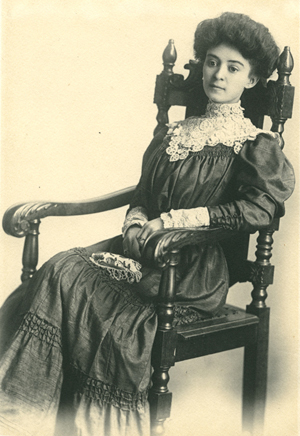
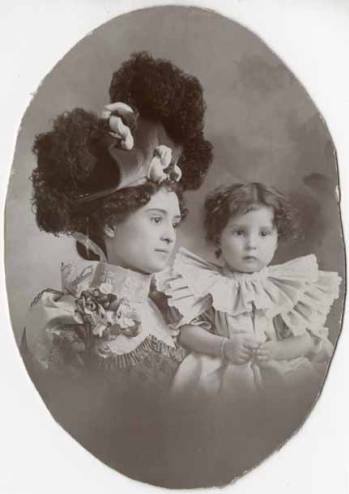
Cleofas Martinez was born on December 6, 1878, into one of the pioneering families of Arroyo Hondo, a small community north of Taos, New Mexico. She was the next to youngest of seven children and grew up in a large adobe family home that reflected both the prosperity and deep Catholic faith of the Martinez family. The house even contained its own private chapel, a reminder of the central place religion occupied in the lives of many prominent Hispano families of northern New Mexico during the late nineteenth century.
Cleofas's education began early. At only nine years old, she left the security of her family home to attend school with the Sisters of Loretto in Taos, where she lived as a boarder. It was an important transition for a young girl raised in rural northern New Mexico, but one that would shape the rest of her life. She later continued her education at the Loretto Academy in Santa Fe, one of the territory's leading schools for young women.
The distance between Santa Fe and Arroyo Hondo meant that visits home were not always easy. During important religious holidays, however, an aunt living in Santa Fe would arrange for Cleofas to return north so that she could celebrate with her family. Her education remained a priority. At a time when many young women married relatively early, Cleofas was determined to complete her schooling before considering marriage.
Her life changed while attending the wedding of a relative in Abiquiú. There she metVenceslao Jaramillo of El Rito, a successful businessman, landowner, and prominent figure in Rio Arriba County. Their courtship was unusual and memorable. Venceslao began sending Cleofas gifts through the mail to her school, gradually making his intentions clear. Among the gifts was eventually an engagement ring—an unmistakable proposal delivered in a manner that must have attracted considerable attention among the young women at the academy.
Cleofas accepted, and the couple were soon married in Taos. Their wedding reflected the prosperity and social position of both families. Her trousseau and provisions for the wedding feast were ordered from Denver and transported to northern New Mexico, illustrating the commercial connections that increasingly linked prominent New Mexican families with cities far beyond the territory.
Following their marriage, Cleofas and Venceslao made their home inEl Rito, where Venceslao maintained extensive business and property interests. Their life together was far from isolated. The couple traveled frequently, including numerous business trips to Denver, which was becoming an important commercial center for northern New Mexico merchants and landowners.
Eventually, the family moved to Denver, where Venceslao owned property and maintained business interests. It was there that their three children were born. Their family life, however, was marked by profound sorrow. Cleofas lost her first two children, tragedies that would have been deeply felt in a family in which faith and kinship were central parts of daily life.
Only their third child,Angelina, survived.
Through her marriage to Venceslao Jaramillo, Cleofas became closely connected with one of El Rito's most influential families. Yet her own story is equally important. Educated at a time when advanced schooling for women was still uncommon, raised within the traditions of northern New Mexico's Hispano communities, and later exposed to a much broader world through travel and life in Denver, Cleofas Martinez Jaramillo represented a generation standing between two eras—the traditional village culture of nineteenth-century New Mexico and the rapidly changing twentieth-century Southwest.