by Dave Warren
Martin’s General Store, El Rito, New Mexico
A preliminary historical reconstruction
I found considerably more information on Martin’s Store than is immediately apparent from ordinary searches. The store was not simply a small grocery; for most of the twentieth century it functioned as one of El Rito’s principal commercial and social landmarks. The evidence also suggests something important about the building itself: the structure appears to predate the Martin family’s ownership and was probably associated with the Sargent mercantile business before it became Martin’s.
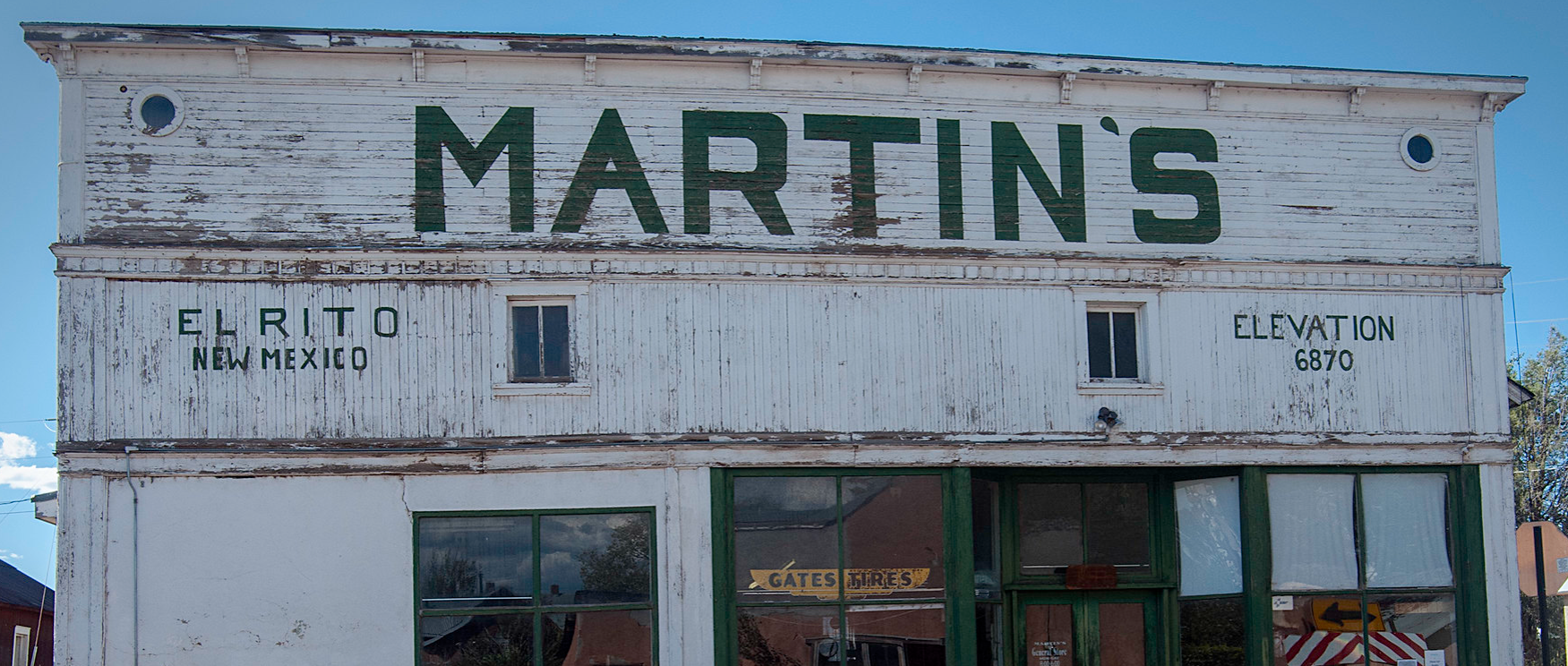
Martin’s Store today
The surviving building is at 1213 State Road 554. Property records used by Realtor.com give a construction date of 1912, although that date is identified as owner-supplied rather than derived from an architectural survey. The building retains the enormous painted MARTIN’S sign across its upper façade, together with “EL RITO NEW MEXICO” and the village elevation.
Before Martin’s: the Sargent connection
The strongest evidence I found indicates that Martin’s grew out of an older mercantile tradition in El Rito. A transcription of Polk’s Arizona and New Mexico Pictorial State Gazetteer and Business Directory for 1912–1913 lists several El Rito businesses. Among them were the El Rito Mercantile Company, a general store operated by Martin Lopez, and, most significantly, “Sargent, J.H., gen store.” It also lists Sargent & Gorzalls operating a saloon.
That 1912 directory entry is significant because later Martin family history says that George Martin eventually became a partner in the Sargent general store. A 2014 obituary for George Martin's son John states specifically that after the family returned to El Rito, George “became a partner in the Sargent general store” and later bought Sargent out.
A photograph of the building taken in 2016 likewise identifies it as having originally been known as the Sargent General Store, although that caption is a photographer's historical description rather than a primary document.
Taken together, these sources suggest a likely sequence:
| Approximate date | Development |
|---|---|
| 1912–1913 | J. H. Sargent is documented operating a general store in El Rito. |
| 1912 | The present Martin’s building is reported as having been constructed about this time. |
| 1925 | George Martin and his family return to El Rito. |
| Late 1920s | George Martin enters into partnership with John Sargent. |
| About 1930 | Martin family recollection places George Martin in business for himself at the site remembered as Martin’s Store. |
| Later 20th century | George’s son Tom Martin operates the business; afterward Tom’s son Greg Martin takes over. |
| c. 1974–2009 | Greg Martin operates the store for roughly the final 35 years. |
| August 31, 2009 | The store closes after more than eighty years of Martin-family business in El Rito. |
| 2017 onward | Major residential renovation/adaptive reuse of the building. |
| 2024 | The former store property is sold again as a residence. |
The most detailed surviving family account comes from a 2025 interview with Michael “Mike” Martin, grandson of George Martin Sr. Mike recalled that his grandfather returned to El Rito in 1925, entered a partnership with a man he remembered as John Sargent/“Sergeant,” and subsequently went into business on his own at the present Martin’s location about 1930.
An important correction to some modern descriptions
Some real-estate descriptions call the property the “1912 Martin’s General Mercantile.” That appears to compress two separate pieces of history. The building may indeed date from approximately 1912, but the Martin family could not have been operating it continuously under the Martin name from that date: family testimony says George Martin left El Rito in 1914 and did not return until 1925, while the 1912–13 business directory specifically identifies J. H. Sargent as an El Rito general-store proprietor. The safer historical conclusion is therefore:
The building probably dates from the Sargent mercantile period and became Martin’s after George Martin entered the Sargent business and eventually took it over.
A deed search through Rio Arriba County would be the best way to prove the exact transfer and date.
George and Margaret Martin
George Martin's connection to El Rito began before his career as a merchant. According to his grandson Michael, George came from Alsace-Lorraine, had attended Manhattan College in New York, and came west in part because of concerns about his health. His education and language skills led him to El Rito's newly established teacher-training institution, the Spanish American Normal School. Michael Martin remembered his grandfather serving as the school's first principal in 1910 and later as president.
George married Margaret Allen in 1912. Margaret was an Irish-born nurse who became an important figure in her own right in El Rito. Known affectionately as “Dambo,” she operated a maternal and child health-care center in the village. George and Margaret raised five children: John, Tom, Roberta, George and Pat.
This helps explain why Martin’s became intertwined with so many aspects of village life. The Martin family was involved not only in commerce but also in education, ranching and health care.
What could you buy at Martin’s?
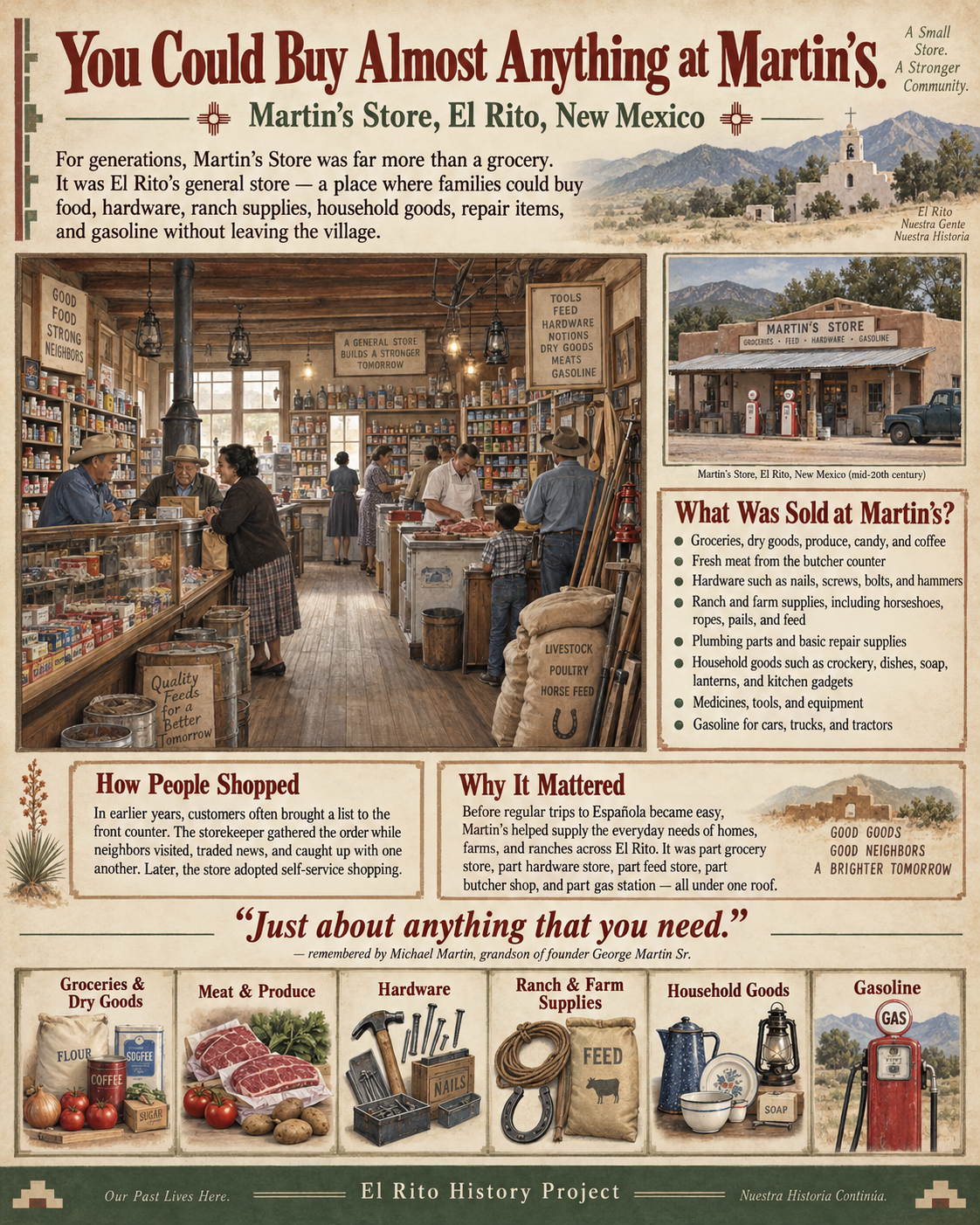
Martin’s was a genuine old-style general store, particularly valuable in an isolated rural community where a trip to Española was once a considerable undertaking. Michael Martin remembered groceries, hardware, dry goods, horseshoes, plumbing supplies, livestock feed and candy. The store also sold gasoline. The 2025 account mentions nails, screws, bolts, hammers, buckets, rope, medicines, dishes, soap, lanterns, chicken feed and kitchen supplies.
In its earlier years, Martin’s operated much differently from a modern supermarket. A customer did not necessarily walk the aisles and fill a cart. Instead, the customer could give a list to the clerk behind the counter, who gathered and weighed the requested goods. Eventually Martin’s adopted more of the self-service system familiar today.
The store employed local people as well. A comment attached to the Martin family interview from Evangeline Martinez recalls working there during summers with Greg and Josie Martin. Another El Rito resident, Raymond Ortega, recalled Greg Martin extending credit to him as a teenager so that he could buy a chainsaw, with the agreement secured largely by a down payment and a handshake. Ortega also remembered men drinking coffee and visiting in the back of the store, Lala Vasquez working the register, and the butcher, gas pumps and garage operations. Those are personal recollections rather than independently documented records, but they illustrate the place the store occupied in community memory.
More than a store: a village landmark
One of the most interesting pieces of evidence I found comes from an oral history preserved by the University of New Mexico. Dr. Richard E. Brubaker described making rural obstetrical calls in northern New Mexico during the mid-twentieth century. Roads often had no names, and doctors depended upon recognizable landmarks where families could meet them and guide them to remote homes.
For El Rito, Brubaker remembered that patients' families would meet him in front of Martin’s Store. That small detail is important. It shows that Martin’s was so well known that it functioned as a geographic reference point for the entire village—not simply as a business.
Its location near the post office reinforced that role. Residents could come into the central part of El Rito to collect mail, purchase groceries and hardware, buy feed, get gasoline and visit with neighbors. Martin’s effectively served as an informal community gathering place.
The Martin generations
George Martin Sr. eventually passed the commercial side of the family enterprise to the next generation. His son Tom Martin ran the store, followed by Tom's son Greg Martin. Michael Martin recalled Greg operating it from approximately 1974 until its closure in 2009.
By the final decades of the twentieth century, however, rural retailing was changing. Better highways and greater automobile ownership meant El Rito residents could increasingly shop in Española, Abiquiú and other communities. Large stores could offer greater variety and lower prices. A general store that once served virtually every daily need now had to compete with businesses many miles away that were no longer perceived as prohibitively distant.
Martin’s nevertheless retained one particularly important service: gasoline. Family recollections indicate that it was the last place selling gasoline in El Rito when it closed. Afterward, residents had to travel elsewhere even to purchase fuel.
The closing of Martin’s — 2009
There is a small date discrepancy in the published record. The 2025 Abiquiu News article gives August 29, 2009 as the last day, but a photograph taken after the closure preserves the actual announcement that Greg and Josephine “Josie” Martin had placed in the store window.
That notice stated that Martin’s would close August 31, 2009, and said the business had served El Rito for more than eighty years. Because the surviving notice is effectively a contemporary primary source, August 31, 2009 is the date I would use for an El Rito Library exhibit.
Photographer Helen Orozco visited in January 2012. Looking through the windows, she found chairs, shelving, clocks, signs and merchandise still remaining and described the store as essentially a time capsule.
See Helen Orozco's 2012 photograph of Martin’s, including the closing notice
The building after the store closed
The old building survived rather than being demolished. Publicly reported property information lists it as a roughly 3,526-square-foot structure at 1213 State Road 554, built about 1912. Residential building, mechanical and electrical permits appear in 2017, showing the period when substantial conversion work was occurring.
The former store was eventually adapted for residential use while much of its historic exterior character was retained, most notably the huge MARTIN’S lettering. The property was listed for sale in October 2023 and sold on April 5, 2024.
That survival is fortunate. Despite losing its commercial function, the building remains one of the most immediately recognizable pieces of El Rito's twentieth-century streetscape.
WHAT COULD YOU BUY THERE?
- Groceries and food: everyday groceries, dry goods, candy and produce; a longtime El Rito resident also remembered George Lucero working as the butcher, indicating that fresh meat was sold. Coffee was available in the back of the store.
- Hardware: nails, screws, bolts, hammers and other basic tools.
- Ranch and farm supplies: horseshoes, ropes, pails, livestock and chicken feed, and related agricultural necessities.
- Plumbing and repair supplies: plumbing parts and miscellaneous items needed to maintain homes, barns and ranch equipment.
- Household goods: crockery, dishes, soap, lanterns and kitchen gadgets.
- Medicines and basic health supplies.
- Tools and equipment: one former El Rito resident specifically recalled buying his first Skil chainsaw from Greg Martin on credit when he was sixteen.
- Gasoline: Martin’s operated gas pumps and eventually became the last place in El Rito selling gasoline. Residents could fuel tractors as well as cars and trucks.
The store apparently carried an exceptionally broad inventory. The Abiquiú News account summarizes it as groceries plus “horseshoes, nails, screws, bolts, and hammers, pails, ropes, medicines, crockery and dishes, soap, lanterns, chicken feed, kitchen gadgets”—essentially whatever an El Rito household or ranch might need.
There is also an interesting detail about how people shopped there. In its earlier years, customers did not walk the aisles filling baskets. There was a large counter at the front. A customer brought or recited a shopping list, and the storekeeper gathered the merchandise while the customer waited and visited with neighbors. Martin’s later converted to the self-service style familiar today.
That helps explain Martin’s importance to El Rito. It was effectively a grocery store, hardware store, feed store, small department store, butcher shop and gas station under one roof. Because travel to Española was considerably more difficult in earlier decades, Martin’s supplied many necessities that otherwise required a substantial trip. Michael Martin recalled that in the 1920s many residents still depended on horses, teams and wagons, and that even during the 1960s a trip to Española could be a major undertaking.