
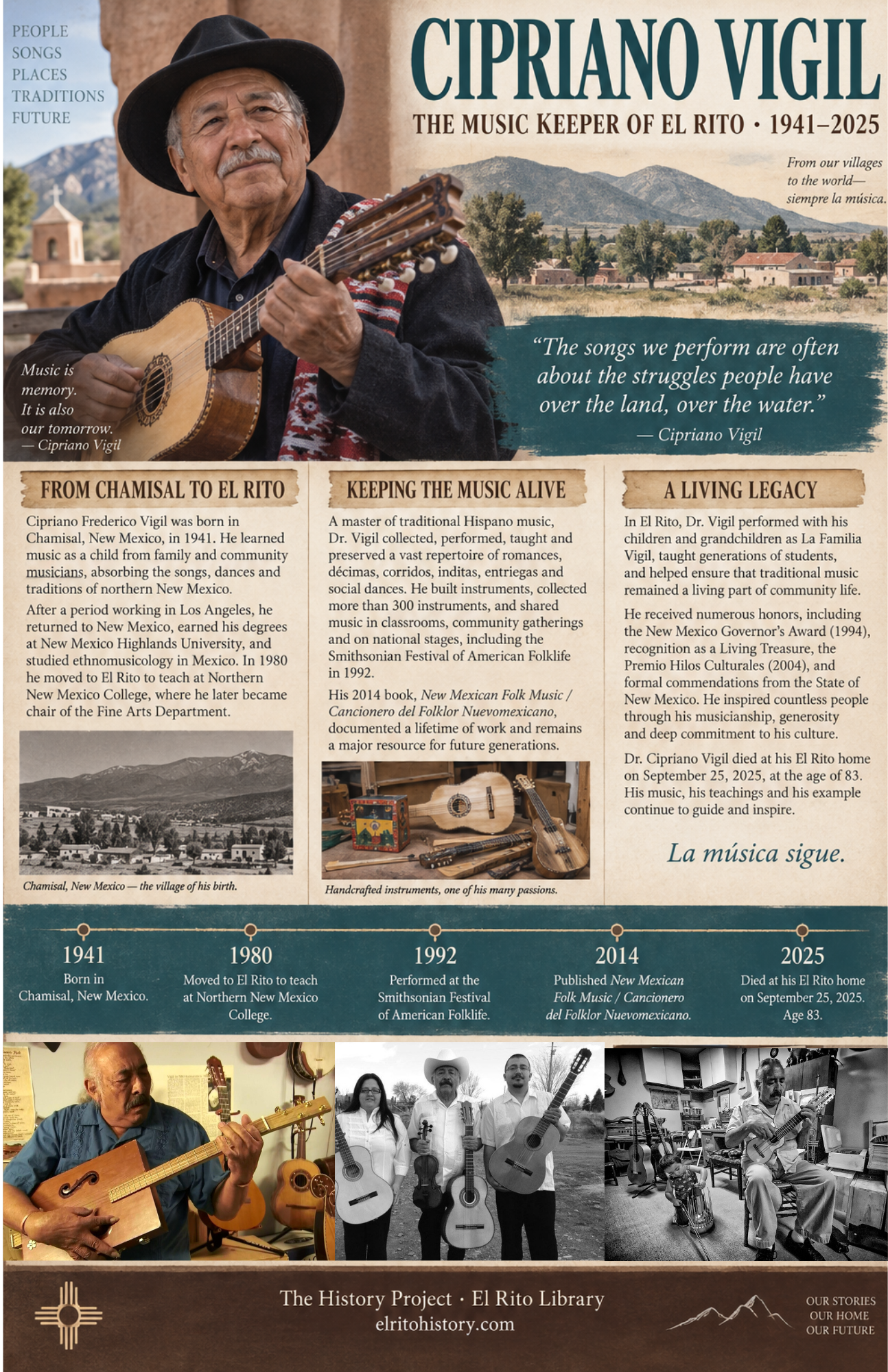
Cipriano Frederico Vigil
A True Account of the Life of a Northern New Mexico Musician, Scholar, and Tradition Keeper
Chamisal, New Mexico, 1941 – El Rito, New Mexico, 2025
Cipriano Frederico Vigil became closely identified with El Rito, New Mexico, where he lived for decades, raised a family, taught, made instruments, performed, and participated in the artistic life of the village. Yet an accurate account of his life begins with an important distinction: Vigil was not born in El Rito. He was born in Chamisal, New Mexico, in 1941. He moved to El Rito in 1980, and it was there that much of the mature work for which he became nationally recognized took place.
His importance reaches far beyond the story of one musician. Vigil became one of the leading twentieth- and early twenty-first-century interpreters and preservers of the traditional Hispano music of northern New Mexico. His work connected the intimate musical world of rural villages such as Chamisal and El Rito with universities, museums, concert stages, classrooms, scholarly publications, and eventually the Smithsonian Institution. In 2018, the New Mexico House of Representatives formally honored him for his contributions to preserving the state's folk music.
A Childhood in Chamisal
Vigil described his own beginnings with unusual clarity. In the prologue to his major 2014 work, New Mexican Folk Music/Cancionero del Folklor Nuevomexicano, he stated that he was born in Chamisal in 1941, when much of rural northern New Mexico was still comparatively isolated from the wider American culture. The music, dances, stories, religious customs and community celebrations he encountered as a child were not historical subjects to him. They were part of everyday life.
His parents were Rubén Vigil and Catalina. His 2025 obituary identifies his mother as Catalina Dominguez, while Vigil himself dedicated his 2014 book to his mother as Catalina "Kate" Vásquez. The available sources do not explain the difference in surnames. His father, Rubén Vigil, was himself among the musicians from whom Cipriano later learned traditional songs.
Music attracted him almost from the beginning. Vigil remembered beginning to learn guitar when he was only seven or eight years old. A Chamisal neighbor, Leonardo "Lalo" Pacheco, owned a guitar and allowed the boy to use it. Initially Vigil could play it only while visiting Pacheco's home. As the older man became convinced that the boy would take care of the instrument, he allowed Vigil to borrow it over weekends. Pacheco knew only a few chords, but to the young Vigil they were enough to open an entirely new world.
The boy's determination went well beyond ordinary music lessons. Vigil later recalled slipping away to dances when he was eight or nine years old, positioning himself near musicians and drawing pictures of guitar finger positions on scraps of paper. He would return home and try to reproduce what he had observed. While other children played sports, he remembered sitting apart with a guitar. In a very literal sense, his later work as an ethnomusicologist began before he knew the word ethnomusicology. He was already observing, recording and reproducing the musical practices of his community.
Another decisive influence was Luz López, one of the most respected musicians in the region. Between approximately twelve and fourteen years old, Vigil began spending time with López, watching closely as he played different instruments. By fourteen, Vigil was sufficiently proficient that López asked Vigil's mother for permission to take him along to perform at dances. Because some of the dances occurred in establishments where a fourteen-year-old normally could not enter, permission also had to be secured from the owners. Vigil later credited López and Lalo Pacheco as his original musical mentors. Other important influences included violinist Cleofes Ortiz, Manuel Pacheco, and Vigil's father, Rubén.
This distinction is crucial to understanding Vigil's later scholarship. He did not first discover traditional Nuevomexicano music in a university archive. He encountered it in kitchens, dance halls, family gatherings, religious observances, bars, weddings and community celebrations. Only later did academic study provide a vocabulary and framework for something he already knew through experience.
Leaving New Mexico—and Returning
Like many northern New Mexicans of his generation, Vigil at one point left the region in search of work. His family obituary records that he moved to Los Angeles and worked for McDonnell Douglas Aircraft. He eventually returned to New Mexico. The surviving publicly available accounts do not provide enough detail to establish precise dates for every stage of this period, and it would be inappropriate to invent them.
His return proved decisive.
Vigil attended New Mexico Highlands University in Las Vegas, New Mexico. State records credit him with earning a bachelor's degree in music education and a master's degree in bilingual education there. He subsequently received a Mexican government scholarship for further study in Mexico, where he studied ethnomusicology.
The period in Mexico exposed Vigil to a much broader world of Latin American traditional music. He studied not merely through formal instruction but through the same method he had used as a child: he went wherever music was being performed. Accounts of his life describe him visiting dances, bars and other gathering places and absorbing different styles directly from musicians. He also apprenticed with the influential Mexico City ensemble Los Folkloristas in the late 1960s. That experience helped connect his northern New Mexican traditions with the larger Latin American folk revival and with Nueva Canción, a movement that combined traditional musical forms with commentary on contemporary political, economic and social issues.
Music, Culture, and La Academia de la Nueva Raza
Vigil's development was also shaped by the cultural ferment occurring in northern New Mexico during the late 1960s and 1970s. While studying at Highlands, he became involved with La Academia de la Nueva Raza, an intellectual and cultural movement rooted in northern New Mexican communities. The Academia sought to treat the knowledge of local people—especially elders—as legitimate history rather than material subordinate to outside academic interpretation.
In 1970–1971, Vigil became an important participant in an oral-history project that produced Entre verde y seco, an anthology of folklore, oral history, poetry and music. The project reinforced something he had believed since childhood: many traditions were disappearing, and elderly residents possessed songs and stories that could vanish with them.
Vigil began systematically expanding the collection he had informally started as a boy. He listened to older residents, wrote down songs, recorded performances and learned pieces directly from the people who remembered them. Later, during the 1980s, he helped initiate a more formal field-recording project involving scholar Enrique Lamadrid, folklorist and sound recordist Jack Loeffler, and photographer Jack Parsons. Vigil provided something essential that an outsider could not easily duplicate: he knew the communities, knew which elders possessed particular songs and stories, and had the trust necessary to gain access to them.
That work ultimately contributed not only to Vigil's own archive but to scholarship by Lamadrid and Loeffler. The Library of Congress bibliography for Hispano music of the Northern Rio Grande includes Lamadrid's research on Vigil's repertoire, including a 1990 study of las entriegas, the ritual songs associated with important community passages.
El Rito
The decisive El Rito chapter began in 1980.
New Mexico Magazine records that Vigil moved to El Rito in 1980 to teach at Northern New Mexico College. The college itself had deep historical roots in El Rito through the former Spanish-American Normal School, and Vigil's arrival placed him in a community where education, traditional Hispano culture and a growing arts community intersected.
He began his career at what was then Northern New Mexico Community College in 1980. He later became chair of the Fine Arts Department, a position state sources say he held for approximately ten years. He officially retired in 2004 but continued teaching folk music part-time afterward.
Vigil's connection to El Rito therefore became much more than a mailing address. It became his home and the base from which he carried northern New Mexico music to audiences across the state and nation. He participated in the El Rito Studio Tour, made musical instruments at his home, and accumulated an extraordinary collection of instruments. New Mexico Magazine reported more than 320 instruments, while state sources conservatively describe his collection as numbering more than 300.
One of his favorite later projects brought him back to the homemade instruments of childhood. He constructed cigar-box guitars, sometimes making matching amplifiers, and demonstrated unusual instruments for schoolchildren. The circle was almost perfect: the child who once improvised guitars from boxes eventually became an internationally recognized musician who taught another generation that music did not have to begin with expensive equipment.
Scholar and Tradition Bearer
Vigil earned recognition as an ethnomusicologist as well as a performer. New Mexico's official 2018 legislative memorial states that he completed a doctorate in ethnomusicology in 1988. Some biographical sources identify his postgraduate studies with El Centro Nigromante in Mexico and Kennedy-Western University in San Diego. The public sources located for this account do not provide a dissertation title, so that detail should not be added without further archival documentation.
What is beyond dispute is the scale of his fieldwork. For decades Vigil recorded, transcribed, remembered and performed traditional material. Unlike a collector who deposited songs in an archive and stopped there, Vigil repeatedly returned the music to the community. He taught it to students, performed it publicly, recorded it with his family and composed new material in traditional forms.
His repertoire encompassed romances, décimas, corridos, trovos, inditas, entriegas, canciones, social dances and other regional forms. He also wrote Nueva Canción compositions addressing contemporary subjects. Scholar Enrique Lamadrid characterized him as a community musicologist whose enormous repertoire represented decades of listening, performing and singing.
In 1992, Vigil performed at the Smithsonian Festival of American Folklife in Washington, D.C. Archival Smithsonian documentation identifies him performing Spanish Colonial music alongside Antonia Apodaca and Cleofes Ortiz. The Smithsonian Folkways album Music of New Mexico: Hispanic Traditions, released the same year, includes Vigil performing "La Julia."
La Familia Vigil
Vigil also ensured that the tradition remained a family tradition rather than simply an academic specialty.
His son Cipriano Pablo Vigil Jr. and daughter Felicita Vigil Piñón performed with him for more than twenty-five years as La Familia Vigil. Eventually grandchildren joined them as well, including Marisol, Mitzael and Alonzo. The result embodied exactly what Vigil had spent his career arguing: traditional music survives principally when it moves from one generation to another through living practice.
Recordings associated with him included Cipriano Vigil y Su Familia, La Familia Vigil, and Los Folkloristas de Nuevo Mexico.
His Great Work
The largest published expression of Vigil's life's work appeared in 2014 when the University of New Mexico Press published New Mexican Folk Music/Cancionero del Folklor Nuevomexicano: Treasures of a People/El Tesoro del Pueblo.
It was not merely a songbook. The bilingual volume documented ritual music, romances, décimas, corridos, social dances, dramatic traditions, songs and Nueva Canción. Lamadrid described the material as the product of roughly half a century of listening, playing and singing. Even then, the book reportedly represented only a portion of Vigil's accumulated archive.
Vigil explained the purpose himself in intensely personal terms. The music was not simply material he had studied; it was the culture in which he had lived. His goal was to preserve traditions while people who remembered them could still be heard.
Recognition
His work eventually brought substantial recognition. He received the New Mexico Governor's Award in 1994 and recognition from the New Mexico humanities community and the Smithsonian. He was honored as a Living Treasure, received the Premio Hilos Culturales Traditional Folk Artist Award in 2004, was formally recognized by Governor Susana Martinez in 2017, and in 2019 became a New Mexico Music Commission Platinum Music Award honoree.
In 2018 the New Mexico House of Representatives adopted House Memorial 22, formally recognizing Cipriano Frederico Vigil for his contribution to creating and preserving New Mexico folk music. By then his work had taken him from elementary classrooms to the Smithsonian, yet he continued to be identified with the small communities from which the music originated.
The Final Years in El Rito
Vigil remained active long after formal retirement. He continued performing, teaching traditional music and dances, appearing with his children and grandchildren, building instruments and representing northern New Mexican culture.
As recently as February 2025, the New Mexico Museum of Art announced a performance and lecture by La Familia Vigil, describing him as a musician who had dedicated his life to preserving and disseminating the music of his ancestors.
Cipriano Vigil died at his El Rito home on September 25, 2025, after a lengthy illness. He was 83. His obituary records that he was surrounded by family. He was survived by his wife of forty-seven years, Susan Vigil, children Cipriano Vigil Jr. and Felicita Piñon, grandchildren and a great-granddaughter, along with several siblings. His obituary also notes the deaths before him of his son Fred Lopez and stepson Luis Tafoya.
A celebration of his life was appropriately held at Northern New Mexico College's Fine Arts Theatre in Española on October 11, 2025—the institution where he had spent so much of his professional life teaching northern New Mexicans that their own music deserved study, preservation and pride.
Cipriano Vigil and the History of El Rito
For an El Rito history, Cipriano Vigil occupies an unusual and important place. He was not an El Rito native, and an exhibit should not describe him as one. He was a Chamisal-born Nuevomexicano who chose El Rito as his home in 1980 and remained associated with the village for roughly forty-five years, until his death there in 2025.
That distinction actually makes his place in El Rito history more interesting.
El Rito became the setting for the mature phase of his life's work. From this small village he preserved songs whose roots extended back generations; taught students; created and collected instruments; participated in the village's artistic community; performed with his children and grandchildren; and carried the musical traditions of northern New Mexico to national audiences.
Cipriano Vigil did not regard folk music as something belonging exclusively to the past. For him, preservation meant using it—singing the old songs again, teaching the dances, composing new corridos, putting instruments into children's hands and giving succeeding generations a reason to make the tradition their own.
That may be the most accurate way to understand his legacy in El Rito. He was not simply a collector of northern New Mexico's past.
He was one of the people who kept that past alive long enough to become part of the future.