
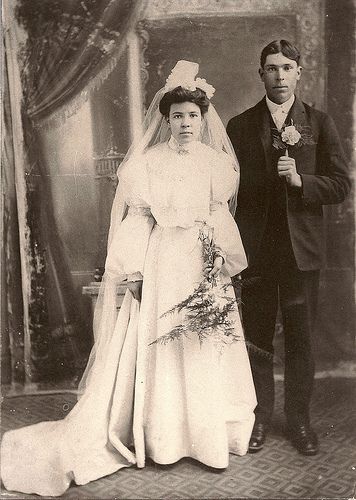
New Mexico Wedding 1906
Marriage and Household Customs
How Two Families Became One in El Rito
In older El Rito, marriage was never understood as a private agreement between two individuals alone. It joined households, property, labor, religious obligations, and generations of relatives. A successful marriage helped determine where a couple would live, whose fields they would cultivate, which acequias they would maintain, and how elderly parents and future children would be supported.
The most complete record of these customs is Celebración del Matrimonio, filmed in El Rito during the 1983 wedding of Cecilia Martínez and William Romero. The film combines the actual wedding with recollections from older residents, including José Rómulo Martínez and Presciliana Ortega, and explanations from Father Jerome Martínez y Alire. It was released by filmmaker Margaret Hixon in 1986. Folkstreams
Preparing to establish a household
José Rómulo Martínez remembered that a young man who wanted to marry first had to demonstrate that he could support a household. He might leave home to herd sheep or perform other work for a year, saving enough money to pay for the wedding and begin married life.
This period of work was an economic test. It showed the prospective groom’s parents—and the bride’s family—that he possessed discipline, reliability, and the ability to provide. In a farming and ranching village, readiness for marriage meant more than reaching a certain age. It required the capacity to contribute labor and resources to a household.
The bride brought resources as well. Presciliana Ortega recalled receiving a small trunk containing clothing, necklaces, rings, and her wedding dress. This was remembered as her dowry or marriage property. Such items were not merely ornamental. Clothing and textiles represented many hours of household production, and jewelry could serve as portable family wealth.
Asking for the bride
When a young man was ready, he did not ordinarily approach the woman’s family alone. His father, godfather, and other male relatives formed a delegation. In some accounts, the groom’s mother and godmother also participated.
The delegation visited the young woman’s home but did not immediately state its purpose. The families first exchanged formal courtesies and discussed their longstanding relationship. They might speak about family character, property, land, or how the proposed union would benefit both households.
Before leaving, the groom’s representatives presented a written request for the young woman’s hand.
José Rómulo Martínez preserved the actual 1909 proposal letter sent when his sister Amada Martínez was asked to marry. Its language was highly formal and religious, describing the son’s admiration for the daughter’s qualities and requesting that they be united through the sacrament of matrimony. Folkstreams
The letter transformed a personal courtship into a respectful negotiation between families. It also created a written record of serious intention.
Here is the English translation of the 1909 proposal letter:
Complete English translation
El Rito, New Mexico
December 31, 1909Señores Don Jesús Martínez and Doña Benigna L. Martínez
Dearest Sirs of my Highest Esteem,
Being that the Highest and wise providence of the Creator is that which leads to the place of his calling, I will manifest to you that my humble son Clemente Abel Trujillo your faithful servant has manifested to me that having been inclined towards the fine and beautiful qualities that adorn the illustrious Señorita your daughter Amada Martínez: He has implored me to request the hand of your daughter for our son so that they be united in the indissoluble bonds of the Sacrament of Matrimony according to what Our Mother the Holy Church has ordained.
So it is that I place this our request in your hands so that you place it in God’s and make it known to the would be betrothed, and you will respond to me with an answer to our request, or whatever to you is most convenient, I remaining your most humble servant.
That Your Hand Does Kiss,
Germán Trujillo
Marriage and Household Customs
How Two Families Became One in El Rito
In older El Rito, marriage was never understood as a private agreement between two individuals alone. It joined households, property, labor, religious obligations, and generations of relatives. A successful marriage helped determine where a couple would live, whose fields they would cultivate, which acequias they would maintain, and how elderly parents and future children would be supported.
The most complete record of these customs is Celebración del Matrimonio, filmed in El Rito during the 1983 wedding of Cecilia Martínez and William Romero. The film combines the actual wedding with recollections from older residents, including José Rómulo Martínez and Presciliana Ortega, and explanations from Father Jerome Martínez y Alire. It was released by filmmaker Margaret Hixon in 1986. Folkstreams
Preparing to establish a household
José Rómulo Martínez remembered that a young man who wanted to marry first had to demonstrate that he could support a household. He might leave home to herd sheep or perform other work for a year, saving enough money to pay for the wedding and begin married life.
This period of work was an economic test. It showed the prospective groom’s parents—and the bride’s family—that he possessed discipline, reliability, and the ability to provide. In a farming and ranching village, readiness for marriage meant more than reaching a certain age. It required the capacity to contribute labor and resources to a household.
The bride brought resources as well. Presciliana Ortega recalled receiving a small trunk containing clothing, necklaces, rings, and her wedding dress. This was remembered as her dowry or marriage property. Such items were not merely ornamental. Clothing and textiles represented many hours of household production, and jewelry could serve as portable family wealth.
Asking for the bride
When a young man was ready, he did not ordinarily approach the woman’s family alone. His father, godfather, and other male relatives formed a delegation. In some accounts, the groom’s mother and godmother also participated.
The delegation visited the young woman’s home but did not immediately state its purpose. The families first exchanged formal courtesies and discussed their longstanding relationship. They might speak about family character, property, land, or how the proposed union would benefit both households.
Before leaving, the groom’s representatives presented a written request for the young woman’s hand.
José Rómulo Martínez preserved the actual 1909 proposal letter sent when his sister Amada Martínez was asked to marry. Its language was highly formal and religious, describing the son’s admiration for the daughter’s qualities and requesting that they be united through the sacrament of matrimony. Folkstreams
The letter transformed a personal courtship into a respectful negotiation between families. It also created a written record of serious intention.
The bride’s answer
Father Jerome remembered that the bride’s family might wait approximately a week before responding. During that interval, the family discussed the proposal and consulted the young woman.
The surviving testimony reveals an important tension. Father Jerome remarked that the family had “hopefully” consulted the bride, while Presciliana Ortega recalled being uncertain whether she wanted to marry a young man she scarcely knew. Her friends had noticed him watching her during a game of chueco and told her that he intended to ask for her.
This should not be romanticized as a system in which every bride exercised equal choice. Family expectations, economic need, parental authority, and community reputation could exert considerable pressure. Nevertheless, the ceremony of giving an answer provided a socially recognized moment at which the proposal could be accepted or rejected.
If the answer was favorable, the bride’s family returned a letter of agreement. If it was unfavorable, they might send a calabaza—a pumpkin.
According to Father Jerome, the words “yes” and “no” were deliberately avoided. The letter or pumpkin conveyed the decision while allowing both families to preserve their dignity. The rejected young man received an answer, but he and his household were spared a public verbal refusal.
The padrinos
Godparents played a central role throughout the marriage process. The padrino and madrina did more than serve as ceremonial witnesses. They assumed an enduring responsibility toward the couple.
They helped negotiate the proposal, sponsored portions of the wedding, provided ritual objects, counseled the couple, and offered assistance during later household difficulties. Their relationship with the newlyweds extended beyond the wedding day.
Marriage therefore enlarged the couple’s support system. Husband and wife were joined not only to each other’s relatives but also to a network of ritual kinship created through compadrazgo.
Betrothal and the lazo
Father Jerome described an older betrothal custom in which the couple knelt on white cushions before their assembled families. A padrino placed a rosary over their heads, marking their engagement.
During the 1983 wedding, the lazo was again placed over Cecilia and William. Father Jerome explained its symbolism with gentle humor: the couple could not move very far from one another without causing pain.
The lazo represented unity, mutual obligation, and the religious character of the marriage. Its physical form made the social expectation visible—the couple would henceforth move through life together.
The arras
Another important custom was the presentation of the arras, traditionally a set of coins placed in a small decorated box. Father Jerome explained that the groom presented them as a sign of his promise to respect and support his wife.
At the 1983 ceremony, William presented the arras to Cecilia, who accepted them and promised to use them wisely. The exchange symbolized material responsibility, but it also expressed reciprocity: the resources of the household were to be held and managed for the family’s common welfare.
The custom carried assumptions about gender typical of its time—the husband as provider and the wife as household manager. In practice, however, rural El Rito households depended on the economic labor of both spouses.
Women cooked, preserved food, raised children, tended gardens and animals, produced and repaired clothing, cared for the elderly, and frequently worked in schools, stores, or other households. Men farmed, herded, cut timber, repaired acequias and buildings, hauled goods, and often left the village for wage labor. These duties could overlap whenever necessity required.
La bendición
Following the vows, parents and relatives approached the couple to give la bendición, the family blessing.
This moment connected the authority of the Church with the authority and affection of the household. Parents were not simply losing a son or daughter. They were recognizing a new family while promising continued guidance.
The blessing also linked the newlyweds to deceased ancestors whose marriages, labor, and property had made the new household possible. Even when those ancestors were not named aloud, their presence could be felt in inherited land, religious images, wedding clothing, family recipes, and the surnames carried into the marriage.
Leaving the church
After the ceremony, the couple emerged from San Juan Nepomuceno into a public celebration. Older residents remembered musicians greeting the wedding party and gunshots being fired into the air.
The gunfire announced that the marriage had taken place. It transformed a church ceremony into news for the entire village. Today, this practice should be described historically rather than recreated, given its obvious danger.
The wedding party then proceeded to the bride’s home or another large gathering place. By 1983, Cecilia and William’s reception was held in the school gymnasium—an example of how the setting changed while the communal purpose continued.
La marcha
The celebration began with la marcha, a patterned dance introducing the married couple to the assembled community.
Participants formed lines, circled the room, and raised their arms to create a passage through which others moved. Father Jerome described it as a triumphal march of the new family.
La marcha did more than begin the dancing. It placed the couple within a social order. They entered the hall as two individuals newly married by the Church and emerged as a household publicly recognized by their neighbors.
The village feast
Father Jerome observed that there was no such thing as a small wedding in a Hispanic village because nearly everyone was related in one way or another.
The reception table demonstrated the strength of those relationships. Families contributed meat, chile, beans, bread, desserts, and whatever special foods they could provide. Women frequently carried much of the preparation work, while men supplied animals, firewood, transportation, music, drink, or money.
The feast converted private household resources into a public statement of hospitality. Feeding the village honored the couple, the families, and the sacred nature of the occasion.
Father Jerome interpreted the open table as an earthly reflection of the heavenly feast: everyone was invited, and everyone had a place.
The wedding dances
The newlyweds participated in a special waltz, followed by dancing involving relatives and guests. The “dollar dance” allowed community members to dance with the bride or groom while pinning money to their clothing or making a contribution.
This was entertainment, but it was also practical household assistance. The money helped the couple begin married life. Like the feast, it distributed responsibility for the new household across the community.
La entriega
No traditional El Rito wedding was considered complete until someone sang la entriega, sometimes spelled entrega.
The entriega was a long ceremonial song addressed to the bride, groom, parents, grandparents, and padrinos. Its verses could be reverent, humorous, admonishing, and affectionate. It blessed the couple while also instructing them about their new responsibilities.
At Cecilia and William’s wedding, Socorro Herrera sang the entriega. Local musicians included Cipriano Vigil, Vicente Montoya, Margarito Olivas, and Los Rancheros del Norte. The song named and honored the people responsible for supporting the marriage. Folkstreams
In this sense, the entriega functioned as an oral community document. A marriage register recorded the legal and sacramental union, but the entriega recorded its social meaning.
The household after the wedding
The celebration ended, but the marriage joined the couple to an extensive system of obligations.
A newly married couple might live temporarily with one set of parents, occupy rooms added to an existing family compound, or establish a home on inherited or purchased land. The location often depended upon:
- Access to irrigated land
- Water rights
- Livestock and pasture
- Available rooms or building materials
- The needs of elderly parents
- Which spouse stood to inherit property
- Proximity to brothers, sisters, and padrinos
The household was therefore rarely limited to husband, wife, and children. Grandparents, unmarried siblings, widowed relatives, fostered children, compadres, and neighboring cousins might all participate in its work.
Tradition and change
Father Jerome believed that many older customs weakened after World War II. Veterans returned after encountering life beyond northern New Mexico, while other residents moved to cities and western industrial centers for employment. Smaller households, wage labor, automobiles, and American popular culture changed courtship and wedding practices.
By the 1980s, however, some younger residents were recovering selected customs. Cecilia and William did not reproduce an old wedding exactly. Their marriage combined contemporary Catholic practice, personal choice, modern clothing and transportation, a school-gymnasium reception, and older rituals such as the formal family request, lazo, arras, marcha, blessing, and entriega.
The 1983 wedding was consequently both an actual family event and a conscious cultural revival. The film’s older participants explained practices that the younger couple had not experienced fully themselves. Folkstreams
What the oral history establishes
| Custom | Evidence connected to El Rito | Interpretation |
|---|---|---|
| Groom working before marriage | José Rómulo Martínez’s recollection | Demonstrated economic readiness |
| Formal family delegation | Recalled by multiple participants | Marriage joined households |
| Written proposal letter | Surviving 1909 Martínez-family letter | Documented local example |
| Pumpkin indicating refusal | Father Jerome’s oral account | Preserved dignity without verbal rejection |
| Bride’s marriage trunk | Presciliana Ortega’s recollection and filmed trunk | Household property and portable wealth |
| Lazo or rosary | Described historically and used in 1983 | Unity and religious obligation |
| Arras | Explained and used in 1983 | Material support and household stewardship |
| Family blessing | Filmed in 1983 | Parental recognition and continuing guidance |
| Marcha | Filmed at the reception | Public introduction of the new household |
| Village feast | Oral history and filmed celebration | Reciprocal hospitality |
| Dollar dance | Filmed in 1983 | Community financial support |
| Entriega | Performed by Socorro Herrera | Blessing, instruction, humor, and public recognition |
The bride’s answer
Father Jerome remembered that the bride’s family might wait approximately a week before responding. During that interval, the family discussed the proposal and consulted the young woman.
The surviving testimony reveals an important tension. Father Jerome remarked that the family had “hopefully” consulted the bride, while Presciliana Ortega recalled being uncertain whether she wanted to marry a young man she scarcely knew. Her friends had noticed him watching her during a game of chueco and told her that he intended to ask for her.
This should not be romanticized as a system in which every bride exercised equal choice. Family expectations, economic need, parental authority, and community reputation could exert considerable pressure. Nevertheless, the ceremony of giving an answer provided a socially recognized moment at which the proposal could be accepted or rejected.
If the answer was favorable, the bride’s family returned a letter of agreement. If it was unfavorable, they might send a calabaza—a pumpkin.
According to Father Jerome, the words “yes” and “no” were deliberately avoided. The letter or pumpkin conveyed the decision while allowing both families to preserve their dignity. The rejected young man received an answer, but he and his household were spared a public verbal refusal.
The padrinos
Godparents played a central role throughout the marriage process. The padrino and madrina did more than serve as ceremonial witnesses. They assumed an enduring responsibility toward the couple.
They helped negotiate the proposal, sponsored portions of the wedding, provided ritual objects, counseled the couple, and offered assistance during later household difficulties. Their relationship with the newlyweds extended beyond the wedding day.
Marriage therefore enlarged the couple’s support system. Husband and wife were joined not only to each other’s relatives but also to a network of ritual kinship created through compadrazgo.
Betrothal and the lazo
Father Jerome described an older betrothal custom in which the couple knelt on white cushions before their assembled families. A padrino placed a rosary over their heads, marking their engagement.
During the 1983 wedding, the lazo was again placed over Cecilia and William. Father Jerome explained its symbolism with gentle humor: the couple could not move very far from one another without causing pain.
The lazo represented unity, mutual obligation, and the religious character of the marriage. Its physical form made the social expectation visible—the couple would henceforth move through life together.
The arras
Another important custom was the presentation of the arras, traditionally a set of coins placed in a small decorated box. Father Jerome explained that the groom presented them as a sign of his promise to respect and support his wife.
At the 1983 ceremony, William presented the arras to Cecilia, who accepted them and promised to use them wisely. The exchange symbolized material responsibility, but it also expressed reciprocity: the resources of the household were to be held and managed for the family’s common welfare.
The custom carried assumptions about gender typical of its time—the husband as provider and the wife as household manager. In practice, however, rural El Rito households depended on the economic labor of both spouses.
Women cooked, preserved food, raised children, tended gardens and animals, produced and repaired clothing, cared for the elderly, and frequently worked in schools, stores, or other households. Men farmed, herded, cut timber, repaired acequias and buildings, hauled goods, and often left the village for wage labor. These duties could overlap whenever necessity required.
La bendición
Following the vows, parents and relatives approached the couple to give la bendición, the family blessing.
This moment connected the authority of the Church with the authority and affection of the household. Parents were not simply losing a son or daughter. They were recognizing a new family while promising continued guidance.
The blessing also linked the newlyweds to deceased ancestors whose marriages, labor, and property had made the new household possible. Even when those ancestors were not named aloud, their presence could be felt in inherited land, religious images, wedding clothing, family recipes, and the surnames carried into the marriage.
Leaving the church
After the ceremony, the couple emerged from San Juan Nepomuceno into a public celebration. Older residents remembered musicians greeting the wedding party and gunshots being fired into the air.
The gunfire announced that the marriage had taken place. It transformed a church ceremony into news for the entire village. Today, this practice should be described historically rather than recreated, given its obvious danger.
The wedding party then proceeded to the bride’s home or another large gathering place. By 1983, Cecilia and William’s reception was held in the school gymnasium—an example of how the setting changed while the communal purpose continued.
La marcha
The celebration began with la marcha, a patterned dance introducing the married couple to the assembled community.
Participants formed lines, circled the room, and raised their arms to create a passage through which others moved. Father Jerome described it as a triumphal march of the new family.
La marcha did more than begin the dancing. It placed the couple within a social order. They entered the hall as two individuals newly married by the Church and emerged as a household publicly recognized by their neighbors.
The village feast
Father Jerome observed that there was no such thing as a small wedding in a Hispanic village because nearly everyone was related in one way or another.
The reception table demonstrated the strength of those relationships. Families contributed meat, chile, beans, bread, desserts, and whatever special foods they could provide. Women frequently carried much of the preparation work, while men supplied animals, firewood, transportation, music, drink, or money.
The feast converted private household resources into a public statement of hospitality. Feeding the village honored the couple, the families, and the sacred nature of the occasion.
Father Jerome interpreted the open table as an earthly reflection of the heavenly feast: everyone was invited, and everyone had a place.
The wedding dances
The newlyweds participated in a special waltz, followed by dancing involving relatives and guests. The “dollar dance” allowed community members to dance with the bride or groom while pinning money to their clothing or making a contribution.
This was entertainment, but it was also practical household assistance. The money helped the couple begin married life. Like the feast, it distributed responsibility for the new household across the community.
La entriega
No traditional El Rito wedding was considered complete until someone sang la entriega, sometimes spelled entrega.
The entriega was a long ceremonial song addressed to the bride, groom, parents, grandparents, and padrinos. Its verses could be reverent, humorous, admonishing, and affectionate. It blessed the couple while also instructing them about their new responsibilities.
At Cecilia and William’s wedding, Socorro Herrera sang the entriega. Local musicians included Cipriano Vigil, Vicente Montoya, Margarito Olivas, and Los Rancheros del Norte. The song named and honored the people responsible for supporting the marriage. Folkstreams
In this sense, the entriega functioned as an oral community document. A marriage register recorded the legal and sacramental union, but the entriega recorded its social meaning.
The household after the wedding
The celebration ended, but the marriage joined the couple to an extensive system of obligations.
A newly married couple might live temporarily with one set of parents, occupy rooms added to an existing family compound, or establish a home on inherited or purchased land. The location often depended upon:
- Access to irrigated land
- Water rights
- Livestock and pasture
- Available rooms or building materials
- The needs of elderly parents
- Which spouse stood to inherit property
- Proximity to brothers, sisters, and padrinos
The household was therefore rarely limited to husband, wife, and children. Grandparents, unmarried siblings, widowed relatives, fostered children, compadres, and neighboring cousins might all participate in its work.
Tradition and change
Father Jerome believed that many older customs weakened after World War II. Veterans returned after encountering life beyond northern New Mexico, while other residents moved to cities and western industrial centers for employment. Smaller households, wage labor, automobiles, and American popular culture changed courtship and wedding practices.
By the 1980s, however, some younger residents were recovering selected customs. Cecilia and William did not reproduce an old wedding exactly. Their marriage combined contemporary Catholic practice, personal choice, modern clothing and transportation, a school-gymnasium reception, and older rituals such as the formal family request, lazo, arras, marcha, blessing, and entriega.
The 1983 wedding was consequently both an actual family event and a conscious cultural revival. The film’s older participants explained practices that the younger couple had not experienced fully themselves. Folkstreams
What the oral history establishes
| Custom | Evidence connected to El Rito | Interpretation |
|---|---|---|
| Groom working before marriage | José Rómulo Martínez’s recollection | Demonstrated economic readiness |
| Formal family delegation | Recalled by multiple participants | Marriage joined households |
| Written proposal letter | Surviving 1909 Martínez-family letter | Documented local example |
| Pumpkin indicating refusal | Father Jerome’s oral account | Preserved dignity without verbal rejection |
| Bride’s marriage trunk | Presciliana Ortega’s recollection and filmed trunk | Household property and portable wealth |
| Lazo or rosary | Described historically and used in 1983 | Unity and religious obligation |
| Arras | Explained and used in 1983 | Material support and household stewardship |
| Family blessing | Filmed in 1983 | Parental recognition and continuing guidance |
| Marcha | Filmed at the reception | Public introduction of the new household |
| Village feast | Oral history and filmed celebration | Reciprocal hospitality |
| Dollar dance | Filmed in 1983 | Community financial support |
| Entriega | Performed by Socorro Herrera | Blessing, instruction, humor, and public recognition |